Check out my updated links:
Greg's ideas for dozens, music for dozens,
and At Dusk Music,
especially their new CD, "You Can Know Danger" - not a title for Raymond Chandler's next novel, or Bogie's new film, or Governor Arnie's response to commutation - but some excellent songs.
While you're at it, check out my new movie and story blogs.
Tuesday, May 16, 2006


Monday, May 08, 2006
NEWS FLASH: Teens Lie About Sex!!!
Sunday's L.A. Times (May 7, 2006, P. A-21) headlined: "Many Youths Diosregard Their Virginity Pledges, Harvard Study Says."
The story was about a government sponsored study that interviewed 12-18 year olds in 1995 about their sexual activity and then re-interviewed them years later.
14,000 teens - virgins and nonvirgins - when first interviewed, had pledged to abstain from sex until marriage.
Now, the study found that more than half said they had broken their vows within a year.
If that wasn't shocking enough, the article contains the following revelations:
"... Of those who [claimed to have] had sex after telling the interviewers they had taken the pledge, 73% denied having made the pledge" in the first place.
The groups which had praised the virginity pledges as a rapidly growing positive trend toward reducing teen pregnancy and raising moral values sharply criticized the study's findings.
But they should have continued to read. The study should be praised for proving what we have suspected all along. Teens aren't sluts, after all.
In its final paragraphs, the article reveals:
"The adolescents were also unreliable in reporting their sexual experiences.
... More than a quarter of [those who had claimed to be] nonvirgins in the first interview who later took a virginity pledge said in the next interview that they had never had sex."
A researcher conlcuded:
"'This puts a lot of error in these studies...' Virginity pledgers ... are more likely to give bad information - unreliable data - about their sexual history.'"
CAN YOU BELIEVE IT? The teens LIED to adults - AND get this:
WHETHER CLAIMING TO BE VIRGINS OR NON-VIRGINS
So take heart, parents. Your kids are only wannabe skanks ... they dress, act, and talk that way cuz its cool ... but deep down, they're really Sandra Dee ...
Just ask them!
Wednesday, May 03, 2006
Did Texas Execute An Innocent Man?
The L.A. Times today reported that a panel of arson experts has found that a man executed in 1994 for the arson murder of his 3 children was convicted on faulty expert testimony. (Los Angeles Times, May 3, 2006, Page A-16, "Panel Says Faulty Arson Evidence Led To Execution").
The most important issue this development should impact is the rush to speedy executions. The crime in this case occurred in 1991. Cameron Willingham was executed in February, 1994. Texas is proud of its efficiency. The state far surpasses any other in rapid executions.
This case may answer the often shouted demand for "speedy justice." Complaints about lengthy delays and multiple appeals deny the need for thorough review of every aspect of these cases BEFORE the terminal event, not afterward.
Willingham had continued to proclaim his innocence up to the moment he was lethally injected. He had claimed that the fire was accidental, but prosecution expert testimony opined that the fire was of human origin based on interpretation of patterns of burn marks.
I suspect that Texas will defend their actions by denigrating the panel as biased, citing the fact that Barry Scheck of the Innocence Project commissioned the report, although no member of the panel was connected with Willingham's case, and none were paid for their work.
All are apparently independent, well-respected in their field. Their stated concern is that arson investigators are too often field educated firemen who have insufficient training and education in the scientific foundations of thei field.
Previous revelations (including conclusive DNA examination) have proved the unreliability of testimony by eyewitnesses, informants, police officers' versions of defendants' confessions, psychiatric experts, and fingerprint experts.
The unreliability of expert testimony is troubling because it strikes at the judicial system's reliance on scientific evidence as "the best" form of proof. Recent studies have cast doubt on work done by police lab experts in Texas and California, including incompetent analysis of blood, fingerprints, ballistics.
One bad expert employed by a police lab can screw up hundreds of cases.
Another obvious point this case speaks to is whether innocent people have been in fact been executed in recent years.
Although many cases have been documented, prosecutors, judges, elected executives and legislators, and many in the public continue to believe that claims are exaggerated, unproved, involve antiquated practices, or are motivated by soft headed opposition to capital punishment.
The fact that this article was "buried" on Page 16 of the newspaper is also troubling. If these findings are upheld, it should persuade more people that the implementation of the death penalty is fatally flawed.
Monday, May 01, 2006
The Death Penalty is "Dysfunctional," By George!
Today’s L.A. Times (5/1/06; P.B3; “Jurist Decries Death Row Backlog”) reported statements by California’s Supreme Court Chief Justice Ron George that highlighted a perceived crisis in death penalty implementation. George is quoted in the article as calling the process “dysfunctional” because the Legislature has failed to supply enough money to hire new staff attorneys for the Court and to increase the hourly rate for appellate lawyers.
The governor’s spokesperson said he is amenable to do what is needed to speed up executions. Legislators rejected a moratorium on the death penalty last session, but George says their refusal to allocate more money operates as a “de facto” moratorium.
It is true, we are far behind the death leading state, Texas. Since 1978 when the penalty was reinstated here, only 13 have been executed here compared with 355 in Texas. There are now 650 on California’s death row, far more having died there from murder, suicide or “natural” causes than execution. Last year the Legislature authorized $223 million for a “new and larger death row with 768 cells.”
One legislator is quoted as blaming George for not shouting loud enough sooner. He can be blamed for increasing the death row population, but for a different reason. His Supreme Court has affirmed almost every death penalty appeal, finding “harmless error” in trivial mistakes like admitting un-Mirandized confessions, allowing serious prosecutorial misconduct, relying on untrustworthy hearsay evidence, excusing incompetent trial lawyers. The result is that the federal court has had to reverse many of these cases in lengthy and expensive Habeas Corpus proceedings. Of course, critics in support speedier death shift the blame to this "liberal" federal bench.
Anyway, these issues seem to come up annually. Last year, the L.A. Times explored the problem (3/6/05; “Death Row Often Means A Long Life” latimes.com), including the following observations:
I worry about he emphasis of costs as an argument against the death penalty. I fear that instead of our state's scruples against executing people without at least trying to provide competent counsel for them and a thorough check and balance to assure the "correctness" of the punishment, California will go the way of other states and try to get it done wholesale."What we are paying for at such great cost," said UC Berkeley law professor Frank Zimring, "is essentially our own ambivalence about capital punishment. We try to maintain the apparatus of state killing and another apparatus that almost guarantees that it won't happen. The public pays for both sides."
According to state and federal records obtained by The Times, maintaining the California death penalty system costs taxpayers more than $114 million a year beyond the cost of simply keeping the convicts locked up for life and not counting the millions more in court costs needed to prosecute capital cases and hold post-conviction hearings in state and federal courts.
Other states execute much more rapidly than California. Eleven Southern states — led by Texas (337 executions), Virginia (94) and Oklahoma (75) — account for 90% of all executions in the last 27 years. This is partly because California, similar to other non-Southern capital punishment states, dedicates much more time and money to state and federal appeals.
Another important factor is that the U.S. 9th Circuit Court of Appeals, serving California and consisting largely of Democratic appointees, is more likely to hear death penalty petitions than the more conservative appeals courts serving Texas (5th Circuit) and Virginia (4th Circuit).
"We don't turn them [executions] out the way a lot of Southern states do," California Chief Justice Ronald M. George said in an interview. "The virtue of our system is also its vice. We go to such lengths to minimize the possibility of error, and we've built in a lot of delay... "The part I find most dysfunctional is that we have a delay of three to four years between the time the death penalty judgment is imposed by the trial court and the time the defendant is appointed counsel."
George said that 115 death row inmates still have not been appointed lawyers for the first direct appeal to the state Supreme Court that is mandated by state law. And 149 lack lawyers for state habeas corpus and executive clemency petitions.
In recent years, both state and federal courts have increased the incentives for qualified defense attorneys to take death penalty cases. The state Supreme Court offers $125 an hour or fixed fees ranging from $135,000 to $314,000 for capital case defense representation. The federal courts recently increased their hourly rate to $150 for defense lawyers in capital cases.
But even at those rates, only a relative handful of attorneys from the 200,000 licensed to practice in California are willing to devote the years of work and vast number of filings a typical capital case can take. Because of the long appeals process, the delay between sentencing and execution in California averages nearly 20 years. As a result, there is a general graying of the population on death row. According to Department of Corrections statistics, 180 death row inmates are older than 50; 42 are older than 60.
Prison records show that California death row inmates are far more likely to die of natural causes than they are at the hands of the executioner. Since 1978, during the same period that 11 inmates were put to death, 28 died naturally, 12 committed suicide and two were killed in incidents on the San Quentin exercise yard. "The leading cause of death on death row," George said, "is old age." ...
... The public cost of maintaining the death penalty, meanwhile, continues to mount. The annual bill breaks down like this:
• According to Corrections Department spokeswoman Margot Bach, it costs $90,000 more a year to house an inmate on death row, where each person has a private cell and extra guards, than in the general prison population. That accounts for $57.5 million annually.
• Atty. Gen. Bill Lockyer, whose deputies represent the counties during appeals, estimates that he devotes about 15% of his criminal division budget to capital cases, or about $11 million annually.
• The California Supreme Court, which is required by law to review every death penalty case, spends $11.8 million annually for court-appointed defense counsel.
• The Office of the State Public Defender, which represents some death row inmates, has an annual budget of $11.3 million. The San Francisco-based Habeas Corpus Resource Center, another state-funded office, represents inmates and trains death penalty attorneys on a budget of $11 million.
• Finally, federal public defenders offices in Los Angeles and Sacramento, and private attorneys appointed by the federal court system for California cases, receive about $12 million annually.
The resulting $114-million annual cost does not include the substantial extra funds needed to try the complicated capital cases in county courts.
Research by the UC Berkeley School of Public Policy in 1993, the most recent study of its type available, showed that in Los Angeles County, a capital murder trial costs three times more to try than a noncapital murder case, $1.9 million compared to $630,000. One reason for the extra costs is that capital cases require a jury trial for sentencing after guilt has been determined in the first trial.
Typically, capital cases have four times as many pretrial motions, more investigators and expert testimony and much more exhaustive jury selection. Other spending not included in the total are courtroom, staff and filing costs at the California Supreme Court, four federal district courts and the U.S. 9th Circuit Court of Appeals.
In an interview, George estimated that the state's highest court spends about 20% of its time and resources on death penalty cases alone. Federal habeas corpus appeals in death cases are so expensive that the 9th Circuit assigns a U.S. district judge just to review the budgets of each capital case.
For the present, activists both for and against the death penalty are unhappy.
"When we reinstated the death penalty, I don't think anyone believed it would look like it does today," said Dane Gillette, a senior assistant attorney general who overseas the state's death penalty cases. "The system is twisted and corrupted in ways that were not anticipated."
Michael Laurence, director of the Habeas Corpus Resource Center and one of the state's leading capital defense lawyers, sees the whole process as an enormous misuse of resources.
"We put all these resources into litigation where we end up killing one person every two or three years," said Laurence. "What if just a small portion of the money we spent on these cases went for the prevention of child abuse? From my experience, this would have done far more to prevent murders than anything we have done with capital punishment."
Possibly as a result of the high costs and bottleneck on death row, there has been a marked decline in death sentences in recent years. In 1999, juries imposed 42 death sentences. In 2004, the number dropped to nine. But the numbers fluctuate, and new admissions to California's death row continue to exceed by many times the number of executions...."
Friday, April 28, 2006
Death Penalty RE-reconsidered
Some time ago my post called “Death Penalty Reconsidered” gathered some interesting comments. The post was about the California Morales case, in which lethal injection was challenged as a means of execution because it was, possibly, "painful." I then ranted on the ironies of that issue, smirking about how executions should be made painful and public, if the idea was to teach a lesson and to provide solace for victims.
That led me to some more ranting about the concept of “closure” as a rationale for capital punishment from my point of view as both a defense lawyer and a person who has not been able to "close" my impulse to live with ghosts in my past, whether dead or alive.
All this stuff apparently struck some nerves out there in the nether-worldwide webbish ether, because I received more comments than from any other post. Here are some of them, almost all from strangers.
"Doc T" said...
"Dear Mr. Borenstein,"Kelly" said...
"Fantastic post. I would like to answer (my views) on some of the questions you pose on here and debate the Morales issue, if I would be assured of answers. No mud-slinging, no crude and unwanted comments, etc, etc. Just clean and respectful debate. Would you be so kind as to indicate if you are willing? Your other readers can also participate, should they so wish. Other than that, I find your posts hillarious but also very refreshing! Have a super day!"
11:27 PM
"This post is an interesting discussion of an alternative system of implementing the death penalty. It doesn't discuss methods (lethal injection, etc.) but it does discuss why and when it should be used." 12:52 PM"Jem" said...
"Great job on the piece! "Closure" is a complex concept; it alludes to the practical need families/advocates obviously feel to shepherd their loved one's case through the legal quagmire (and, thus, to eventually be free of that perceived responsibility and burden) as well as to an imagined progess through a grieving process. Of these two meanings (practical and psychological), I am much more skeptical about the latter than the former, and I think your beautiful argument here is perfect (why pretend that we can get pyschological closure just because there is a human agent of our bereavement - how would that compensate for, or help us even come to terms with, our emotional loss?).
"Yet, even the practical side has its contradictions. It seems like our legal system has oscillated between:
(1) a basic disregard for "victims' rights" (or those of their survivors) as essentially irrelevent because we are not so much concerned with the crime itself as with the pathology of the criminal ("broken" people that are inherently dangerous need to be quarantined from society, combined with the notion that the crime was an attack on public order and civilization as well as on a specific individual) and
(2) an "eye for an eye" notion of direct compensation (that an aggrieved family should, in some way, be offered disposal of the life of the criminal to recompense the loss of their own loved one).
The trouble with concept (1) is that peole do, occasionally, change in prison (as we have seen in several recent cases), providing the possibility that they are no longer dangerous to society. Yet the crime was comitted and the reform of the criminal does not remove the harm already inflicted. The trouble with concept (2) is that some families may, as you hint at the end of your piece, decide to forgive rather than exact vengeance, if given the chance. This forgiveness would conflict with the state's desire to quarantine the anti-social criminal and punish the attack on social order, and, since this forgiveness is so arbitrary (depending on the hearts of specific loved ones), could lead to differing punishments for similar crimes (i.e., its best to hurt forgiving types, or at least their loved ones). I suppose this is why, despite all the rhetoric about victims' rights, we don't see much actual attention paid to their potential implications.
Perhaps it would be better, all in all, if we separate these very different, but often conflated, concepts and make their relative merits a subject of public discourse.
7:13 PM
"Doc T" replied...
"I can agree that "closure" is a complex process. It differs from person to person and the methodology to achieve this is different in every person. There is no "quick fix" formula or solution.
In my view, the "closure" reason used by many to justify the death penalty, is a picture they paint for themselves, in the hope that they will "feel better". It is my view that the undelying reason, behind the facade of "closure" is pure revenge.
It is my view that victim support services should be predominant during such times, instead of being used as an agent to fuel the revenge issue, which I have seen happen.
Yes, "broken" people should be quarantined for the good of all. Even should they "change" during incarceration and conform to societal norms once again, it should not give them carte blanche to be released into society again. They can continue serving society from where they are.
4:13 AM
"john" said...
"Hello Doct and everyone. I think that revenge is a motivation for pro execution people, but also a sense of duty to a loved one lost is seen. Otherwise I just cannot see any argument for more brutality. I lost my brother to murder, but what "closure" would happen from yet another killing? What, revenge? A sense of duty? Won't bring my brother back. (Group psychotherapy was what gave me "closure"). How can "closure" happen with execution?? And with DNA seeing 122 innocent people taken off death row recently, what if the guy in front of me, being fried with 2,000 volts banged through them, is actually innocent, and the real killer out in the streets because the legal case was closed with execution?? The loss is still there. Deterrent? In Europe, where there is no death penalty, the murder rate is lower than the U.S. (and gun access is restricted too) Where is the definitive argument for more killing? In most cases anyway, the killers are mentally disturbed. They are damaged people themselves with childhood abuse histories. So when does the chain of violence stop? By the state continuing the violence machine?""john" later added ...
5:36 AM
"A therapy process should not direct a person to go in any direction. It is an exploration of, and testing out of feelings in a group feedback environment. So any "therapy" that incites people or directs them to want revenge is not doing its job. Closure is an internal process, not external. Execution is external. I don't see how it resolves the grieving process. In fact, in one sense, execution is counter-productive from a closure sense. "Right, you can stop suffering now, because we have just killed the killer !!" Being "allowed" to grieve for as long as it needs is vital. For me, the justice process alone was sufficient in that the killer had to face it. But my grieving was internal."
5:52 AM
"UnderCoverAnna" said...
"Mr. Borenstein,My addendum:
thank you so much for your thoughtful essay on the death penalty. I was so glad that you dared mention disease as a killer, too. During discussions on another forum, I was afraid to mention that fact. My mother died of Alzheimer's disease: humiliated and tormented, completely stripped of her dignity. While we were watching that cruel punishment, we also had to put up with a host of brainless Alzheimer's jokes (of which you all may have heard a few, too.) More than two years after her death, I still feel tempted to slap people who poke fun of Alzheimer's victims.
Whenever I see an elderly white-haired lady in a wheel-chair, I travel right down memory lane. I know there will never, ever be closure for me.
No matter what, the loss is permanent. So, I would like to tell the family members of muder victims not to expect closure at all -- not from the verdict, not from the execution of the murderer, not from justice having been served. There is no such thing as closure because feelings and emotions cannot be closed like a folder that contains the files of your and your loved one's sufferings.
We can only heal to a point where the pain becomes bearable, where a cruel Alzheimer's joke can't hurt us no longer, and where the images of the agony our loved ones may have suffered have just faded enough to somehow accommodate them in our daily lives.
Thanks again for your article."
9:50 AM
Thank you all for these comments and please keep them coming. It is a miracle that this venue is so full of thoughtful people.
Notes in a bottle dropped into the sea are a form of therapy, aren't they? Evidence that intelligent life does exist in scattered parts of this planet is shocking ...
In my blog, I posted stories about the lives of some of my ghosts, reflecting that maybe the saddest fact of death is that most of us are forgotten when the people who loved us are gone.
Maybe this vehicle --- these blogs that are written by unfamous people about unfamous people --- will prove to be more important than all the blogs written about celebrity gossip or politics or conspiracies ...
Maybe just the idea that a human being's "history" can be sent out into the void, read by strangers, and thereby recalled and treasured, thus providing a kind of immortality, is the best form of "closure" possible.
Friday, April 07, 2006
The Judas Defense
People accuse defense lawyers like me of being able to make an argument for The Devil. Well, I never was retained by Her, but the idea that anyone is entitled to a defense got a boost by the release of The Gospel According To Judas by the National Geographic.
Judas Iscariot, you might recall, was the disciple whose very name became synonymous with Traitor and Informant, accused by the Gospels of Mark, John, Luke, and Matthew of selling out Jesus to the Romans for money.
Now, more than two thousand years after the “crime,” it seems like Judas has come up with a defense after all. And as a criminal defense lawyer, I must say that it is a pretty good one at that.
According to the translation of the Judas Gospel, Jesus told Judas in private conversation to do what Judas in fact did do, turn him in. Thus, the defense is that Judas was not a conspirator in the legalized murder of Jesus, but was instead following the Savior’s orders, in effect carrying out God’s plan to sacrifice His Son for the sins of humanity. So, from a strictly legal viewpoint, Judas was guilty of nothing more than assisting in a suicide, which is apparently lawful in some jurisdictions.
What next? Can I expect a call from Cain, wanting to file a writ of Habeas Corpus to raise the defense of ignorance: since no murders had ever been committed before, Cain didn’t know that his act would result in death, or that it was unlawful to end someone’s life. After all, this preceded The Ten Commandments by... well, many pages.
Tuesday, April 04, 2006
Bush's faith in Democracy: What's so wrong with that?
The core of the problem with America’s Iraq policy is that George Bush and those around him are not lawyers. So they support their arguments with faith based notions.
George Bush is a self-defined Fundamentalist Christian whose rigid religious faith informs his world view. He wants to spread democracy throughout the world in the belief that world peace will result.
This is certainly a noble goal, so what is wrong with it? Why isn’t this the same as Lincoln’s stubborn crusade to preserve the Union during our Civil War, which resulted in 600,000+ American deaths?
Lincoln too was a man of deep religious faith, was uncompromising in his adherence to his principles, despite widespread dissension and protest. He pursued a war of conquest over a self declared “nation” that wanted “self-determination” based on its own values and perceptions that their liberty was being trampled by a majority.
Let’s define our terms and see if we can See The Light.
Faith:
The Bush administration clings to its faith that it can establish “democracy” in the Islamic middle east. It defines “democracy” in the American holistic sense, [definition 5, supra], implying tolerance in a pluralistic society.
The leaders in that part of the world, also calling themselves men of fundamentalist faith, resist these efforts. Majority rule involves adherence to fundamentalist Islam, which, by definition violates American understanding of “democracy.” The difference is that they believe definition 5 violates the demands of their fundamental faith.
[Parenthetically, moderate interpreters of the Qu’uran differ; they point out that under the Caliphate, when Islam controlled a vast realm, “infidels” were tolerated, even encouraged to participate in the society.]
So the difference between Lincoln and Bush?
The South claimed also to be men of strong faith. They found support for their policies in the same Bible that their enemies cited. They also defined “democracy” in a narrower sense, denying the need for pluralism.
Lincoln argued that disunion and slavery were wrong, not merely because his Faith told him so; he had brilliantly expressed logical reasons for his conclusion and his stubborn adherence to his policy. His rhetoric was often couched in the language of faith, but he never lost sight of the reasoning behind his quest.
George Bush is a self-defined Fundamentalist Christian whose rigid religious faith informs his world view. He wants to spread democracy throughout the world in the belief that world peace will result.
This is certainly a noble goal, so what is wrong with it? Why isn’t this the same as Lincoln’s stubborn crusade to preserve the Union during our Civil War, which resulted in 600,000+ American deaths?
Lincoln too was a man of deep religious faith, was uncompromising in his adherence to his principles, despite widespread dissension and protest. He pursued a war of conquest over a self declared “nation” that wanted “self-determination” based on its own values and perceptions that their liberty was being trampled by a majority.
Let’s define our terms and see if we can See The Light.
Faith:
“1. Confident belief in the truth, value, or trustworthiness of a person, idea, or thing. 2. Belief that does not rest on logical proof or material evidence. See synonyms at belief.,trust. 3. Loyalty to a person or thing; allegiance: keeping faith with one's supporters. 4.In Christianity, the theological virtue defined as secure belief in God and a trusting acceptance of God's will. 5. The body of dogma of a religion: the Muslim faith. 6. A set of principles or beliefs.”Fundamentalism:
“1. A usually religious movement or point of view characterized by a return to fundamental principles, by rigid adherence to those principles, and often by intolerance of other views and opposition to secularism...”Democracy:
“1. Government by the people, exercised either directly or through elected representatives. 2. A political or social unit that has such a government. 3. The common people, considered as the primary source of political power. 4. Majority rule. 5. The principles of social equality and respect for the individual within a community.”[The American Heritage® Dictionary of the English Language: Fourth Edition. 2000.]
The Bush administration clings to its faith that it can establish “democracy” in the Islamic middle east. It defines “democracy” in the American holistic sense, [definition 5, supra], implying tolerance in a pluralistic society.
The leaders in that part of the world, also calling themselves men of fundamentalist faith, resist these efforts. Majority rule involves adherence to fundamentalist Islam, which, by definition violates American understanding of “democracy.” The difference is that they believe definition 5 violates the demands of their fundamental faith.
[Parenthetically, moderate interpreters of the Qu’uran differ; they point out that under the Caliphate, when Islam controlled a vast realm, “infidels” were tolerated, even encouraged to participate in the society.]
So the difference between Lincoln and Bush?
The South claimed also to be men of strong faith. They found support for their policies in the same Bible that their enemies cited. They also defined “democracy” in a narrower sense, denying the need for pluralism.
Lincoln argued that disunion and slavery were wrong, not merely because his Faith told him so; he had brilliantly expressed logical reasons for his conclusion and his stubborn adherence to his policy. His rhetoric was often couched in the language of faith, but he never lost sight of the reasoning behind his quest.
Friday, March 31, 2006
Argument For The Right To Lie
The recent fuss about the exaggerations discovered in a best-selling “memoir” annoys me. It is not only hypocritical for “journalists,” bloggers and talk show hosts to decry a lack of integrity or adherence to Truth, it is downright un-American.
No, I’m serious. If America stands for anything, it is the right and ability to re-invent yourself as often as you wish. The Founding Fathers did it. Every immigrant and pioneer took advantage of it. “Upward mobility,” the process of overcoming the deficiencies of birth status, is the goal of every right thinking American. Every sinner, including our current president, who insists he is “born again” relies on this right. Bush isn't the only politician whose image was manipulated. Abe Lincoln, a wealthy railroad lawyer, ran for president as "The Rail Splitter."
Our very economic survival depends on every teenager's right to tailor her image: she shops, adopts cool lingo, drives a hip car, listens to pop music, gravitates to a clique of friends.
When defendants testify in their own defense, denying guilt in the face of more credible contrary evidence, most judges will punish them more severely than if they had remained mute. One of my favorite judges was in other respects not a very admirable person. He was irascible even nasty to some lawyers, often so drunk by mid-afternoon that he needed sleep. But he never punished a defendant who testified, recognizing what he called “our constitutional right to lie in our own defense.”
Historical fiction, whether in books or movies, has always been controversial. Distorting facts to make a point is a time-honored practice (Oliver Stone) justified by the demands of asserted “license” and "poetic truth." Whether required for dramatic effect or to underscore the theme, altering the reality is accepted. The familiar claim “based on” or “inspired by true events” is meant to explain the variances and usually it satisfies as a warning that what we are seeing or reading is not meant to be exactly the way it happened.
Biographies of course are notorious for this kind of editing. Real lives are far too complex to be accurately portrayed on screen. Autobiographies are the least reliable sources.
The problem is muddled by works which claim to be “non-fiction.” Documentaries have been reemed when they resorted to “re-creations,” and spawned a sub-genre called “docudrama,” which is frowned upon by serious journalists and historians. Of course those noble professions have also taken hits when fabrications are uncoverd, notably The New York Times and New Republic. Michael Moore’s kind of comical polemic has other problems.
The impulse to alter reality is a most human trait. The need to create "Drama" in our lives is overpowering. It drives our deepest yearning: self-fulfilment. It easily trumps lessons about ethics. Fear of exposure as fraudulent is a nightmare we willingly accept. The risk, after all, is thrilling. We can't help it; we will continue to be "wannabes." It is our nature, our right, our duty.
Friday, March 24, 2006
I Need Help!
It is time for me to admit that I need help. I see the world differently than "normal people" do; therefore, I must be the one who is sick or evil. Here are some of my problems.
I watched a news item about a very sexy woman who was being prosecuted for having sex with her 14 year old male student. I was shocked and awed, but not for the "right" reasons.
This sort of thing seems to happen more often now than when I was 14. I remember leering at a few teachers and indulging in similar fantasies. That's all they were, fantasies. I doubt that if one of them had "abused" her position of authority and "forced" me into sexual slavery with her, it would have ruined my life.
I probably would not have come home that night and answered my mother's casual question: "How was school today?" with a confession. I might have told my pals about it, but of course they wouldn't have believed it because we all lied about things like that all the time.
Item 2: The Supreme Court heard argument in two cases involving "domestic violence" raising the legal issue of whether the defendant could be convicted by the hearsay statement of the victim who failed to testify in the trial. Would the tape of the 911 call violate the Sixth Amendment right to confront and cross examine witnesses?
Spokespeople for battered spouses point out that victims are often too intimidated to testify or are misled into forgiving their offending spouses who always promise never to do it again and too often continue the practice. So, the normal person would certainly answer that correction of rampant injustices to thousands of victimized women trapped in abusive relationships, a major social problem, should trump the legal technicalities that allow guilty men to go free.
Maybe you can guess which side I come down on: yup, I admit that the adherence to the Bill Of Rights is the slim thread I cling to and is a sign of my depravity and social insensitivity.
Certainly not the Liberal, but the "Libertarian," view, though I blush at the term, which has come to mean something more like laissez-faire, which is not exactly what I had in mind, and not the so-called "strict constructionist" view Conservatives like to trot out when it suits them.
On another related subject I am also in the mentally deranged minority. I am not particularly offended by the Bush super secret taping of phone calls to and from Afghanistan. It's not that I like the specter of the government listening in on my calls to Kabul, but I am not impressed by the Liberals' outrage about it. Their position seems tepid at best. They're not opposed to the practice, IF ONLY the taping is ratified by a super super secret judge, who, by the way, always lets it happen anyway.
Kind of like the Liberal opposition to the Iraq War: A fine mess you've gotten us into, but I don't have the foggiest notion whether or how to get out.
These are the sorts of twisted thoughts I've been having. Please stop me before I think again!
Sunday, February 12, 2006
Death Penalty Reconsidered
The recent delay of execution for Michael Morales raises lots of fun questions.
California was temporarily stopped from completing a trifecta: 3 whacks - a Black man (Stanley "Tookie" Williams), a White man (Clarence Ray Allen) and a Hispanic (Morales), thereby reaffirming California as the foremost equal opportunity state.
Morales' snuff party was halted by the inability of the state to comply with a federal judge's concern that the "lethal injection" procedure was "cruel & unusual." The judge was nervous about reports that previous deaths were too painful for the inmate. The state has the power and right to terminate a life, but not to torture or inflict extreme pain. Doctors he ordered to be present to insure that Morales was unconscious when he was administered the lethal cocktail balked, citing their own ethical qualms about their role.
The upshot was an "indefinite" stay of execution while the judge conducts a full hearing. The family and friends of the victim, a 17 year old girl who was beaten, raped and murdered by Morales in 1983, were quoted as being extremely upset with "the system" because they couldn't achieve closure.
My own point of view, as a lawyer who defends capital clients in trials, is a bit different. First, I am a bit amused by the debate over the form of death. Trial lawyers (with our own gallows humor) used to bemoan our futile efforts in bad cases by muttering that the best we could get for a client was a seat on the shady side of the bus to prison.
Personally, I think the worry over a painless death penalty is a sick joke. Why not make it painful and, while we're at it, let's make it public. If it is designed to deter others, to extract vengeance, and to "satisfy" the victim's family, let's see what televised drawing and quartering would accomplish. It would be a surefire reality show hit and some of the proceeds could be given as restitution for the victims.
Secondly, I'm not opposed to Capital Punishment - in theory. Some people have committed such horrible crimes that they simply deserve to die. Executing some people might deter others from killing; at least it will deter that person from killing again. I am not sure that respect for the value of life doesn't justify the forfeiture of one who takes a life. I have sympathy for the victim and loved ones who demand swift justice and closure.
Of all the reasons set forth for death, the hardest for me to deal with as a human and as a lawyer (not yet mutually exclusive, I hope), is the last one above, that the suffering of the victim's family should be vindicated. That one bothered me for a long time.
The evidence of "victim impact" which is now permitted in capital trials is the toughest for defense lawyers to deal with. The victim who was mother, father, son, brother, or friend to someone is gone and it hurts to see the photos and hear the stories of the holes left in the hearts of loved ones.
But then I thought about someone I loved who was killed some years ago. She was tortured for 16 months, in almost constant pain and fear. She was completely innocent, and didn't deserve to die. She was only 46 and she had parents who had survived the Holocaust, a sister, me, her 12 year old son. We all needed her, and I was furious with her killer. It was so unfair; so -- unjust.
But I had no one to focus my vengeful desire on; her killer was cancer. I couldn't even sue the doctors who had tried everything to save her life. Does that mean that I can never have "closure?"
No, while the idea of "closure" by legal system is a powerful emotional argument by death penalty proponents, it is not only a lie, it is a cruel hoax abetted by so-called "therapists." To permit one's grief to be dependent upon any institution is useless and mean. The legal system is not designed for that purpose, nor should it be.
Of course, there can be no justice, no "closure" if the wrong person is executed. Experience has shown that a lengthy, expensive, and thorough appellate process is needed. Closure is thus necessarily delayed for 10 or more years.
Closure is essential no matter the cause of the death of your loved one. Are you less bereaved if you lose someone to disease, accident, negligence, or the many acts of violence that our laws do not categorize as death penalty eligible killings?
Do we want a system that executes people based on the passions of victims? What if the victim or loved ones were opposed to capital punishment? Should that “wish” be honored?
In fact, there are many victims who do not want this result. (See Murder Victims Families For Reconciliation: http://www.mvfr.org/)
By the way, contrary to common sense, the evidence is now clear that the death penalty does not deter others from killing. In Texas, executions are commonplace (355 since 1982), yet the murder rate is higher than New York’s which has 0 executions (6.1 murders per 100,000 population vs. 4.6 in N.Y.). See Death Penalty Information Center and compare the facts. (http://www.deathpenaltyinfo.org/state/).
Wednesday, January 11, 2006
Diversions: M-m-m-my "Generation"
When I am angst-ridden about things I should be doing something about, my mind naturally wanders toward trivia - things I can do nothing about.
Lately, this thinking involves the idea of "Generation." As so often, an argument with Greg triggered the course. He said something about the damage "your generation" did. Whereas the so-called "Greatest Generation" (that of my father) had conquered The Great Depression and Fascism, my generation, the "Me Generation," blew it, frittered away the prosperity, bungled The American Century, and left my son's generation with debts, lowered expectations, downward mobility, and ambiguous ideals.
This, naturally, fed neatly into my guilt feelings. And, given my defensive mentality, I began to construct arguments, a bit late to respond to Greg, whose articulate attack left me stunned and bruised, with lame responses. Like this one:
My generation did the best it could do. We started rebellious movements: the War, Racial and gender equality. We produced Dylan, Lennon, Janis, Spielberg, Scorcese, Clinton.
There is one more thing. I am not a "Boomer." I was a "War Baby," preceding the locust swarm of post-WWII births by a couple of years. And my brother was born 8 years before me, in the midst of the depression. So he is part of my "generation" but we had different sensibilities and experiences.
It struck me that the In-Betweeners like me stand somewhat apart from the crowd of my generation. I remember watching The Beatles on Ed Sullivan's show in 1964 and feeling a bit above it all. I was 21, and my teen frenzy was already wrapped in "oldies." The outrage of Little Richard and Jerry Lee Lewis had passed; Elvis was lost.
I viewed the events of 1968 - the most crucial year of my generation - while studying for the Bar Exam, exploring draft avoidance, politely polling for McCarthy, getting pleasantly high, searching for satisfaction and Truth in The Law. In '72, I polled for McGovern, and by the next year, the Watergate year, I was indeed turned inward, finding Bijou and preparing to escape into "Us" if not "Me."
Then again, what is your "generation" about? Are you an "X" or a "Y" or something in between? Are you really going to "heal the world" or hide from it. Do you have a "Generation?"
Thursday, January 05, 2006
You got troubles?
I received this recent report regarding one of my long time clients:
"This 49 year old woman has been diagnosed with mild mental retardation, epilepsy, a long standing history of drug abuse and suicidal tendencies, history of anemia, organic brain dysfunction, migraine headaches, leg cramping pain, hypertension, hyperthyroidism, bronchitis, osteo-arthritis causing pain in the lower back, hemorrhoids, Dementia, Hepatitis B, fibrocystic breast disease, schizophrenia and bipolar disorder. She also has decaying teeth and difficulty walking."
Thursday, December 01, 2005
Why I Love Golf
 I love golf. The setting sun over the mountains. The cool November L.A. afternoon air. Oh, I admit that it is not really Nature. The courses at Griffith Park are Nature-lite, a manicured, sculpted, tamed, ersatz amusement park form of Nature. But it is wild enough to permit life lessons. Strangers at the first tee become pals by the 18th, like plane crash survivors on the brink of returning to civilization. This guy who joined us is Korean, and by the 18th tee we’re friends of a kind. We have commiserated in our mutual adversity, lost balls, sore feet. The shared experience has bonded us.
In the Asian way, he seeks advice from an elder. Me. “May I ask a stupid question?" he questions. “If you don’t mind a stupid answer,” I answer. The joke crashes the language barrier.
Here’s his question: “Do most men of your age prefer wives or girlfriends?”
A profound question cannot be answered lightly. BC has a different view. “What about both?”
“I have both,” the guy says. “That’s the problem. I read ‘Men are Mars, Women Jupiter.’ I don’t understand it.”
Obviously, but I gently correct him. “‘Women are from Venus.’ It means women care about Love, men about War.”
BC adds, “Men aren’t meant to be monogamous, women are. There’s the problem, right there.”
“Oh,” the guy says. “That’s why my girlfriend makes trouble. She was happy, but lately she makes trouble for me.”
So I am forced to lecture. “Instability is the rule.” I quote Woody, translating into Kor-lish: “Relationship like shark, must keep moving or die. One of your sharks is doomed. Maybe both.”
“But she was so happy. My wife, too.”
I add the corollary: “Dying sharks are the most dangerous.”
The guy is now alarmed. I can’t resist. I embellish: “Men share, women are selfish. A woman always wants the man to herself. Sharing is not an option — not for long.”
The guy slices his drive into the woods.
Walking to the cars, BC says, “He asked me if you were a doctor.”
“What’d you tell him?”
“That you were a plumber.”
In the gathering chilly gloom, we walk in silence for a while. Our clubs clank in our bags in rhythm to our strides. As I reach my car, I shout, “Experience is the father of wisdom.”
It takes BC a while to think of an appropriate comeback, “And you’re the father of bullshit.”
You can learn a lot from golf.
Friday, October 14, 2005
"W" In Prayer Meetin'
Overheard in the oval office:
GWB: Hi, Karl, what’s cookin,’ dude?
KR: Mr. President, there’s some folks here who are mighty het up.
GWB: No kiddin? Who all?
KR: Oh, Jimmy Dobson, Pat Buchanan, Billy Kristol, guys like that.
GWB: Really? They want another prayer meetin’?
KR: No, Georgie. Don’t think that’s gonna do it this time.
GWB: Well, that’s too bad, K. What do I do?
KR: Bring ‘em in and turn on your famous boyish charm, I’d say.
GWB: Oh, sure. Anythin’ y’all say.
[There’s a pause, some background noise, and a round of “Hi, Y’alls” and “God blesses.”]
KR: Why don’t we get down to it, folks? Just tell W what’s itchin’ your shorts, so to speak.
[There is a moment of silence, apparently not a silent prayer, but hesitation. Finally, Kristol speaks up.]
WK: Mr. President, it’s this nomination of Harriet Miers. We’re a bit upset, to tell the truth.
GWB: Really? No kiddin’? I thought Karl gave y’all the wink on that one. Y’all can trust me.”
JD: He sure did, W. But, the thing is, I started in a-prayin’ on it, and I began to doubt my faith.
GWB: Doubt? Lose faith? You?
PB: With all respect, Mr. President —
GWB: Hey now, in here I’m just old W, okay?
PB: Okay, er, W, we all are nervous because we been a-waitin’ all our lives for this moment.
WK: That’s right, got control of the Congress, and now, praise the Lord, we finally get another seat on that — pardon my blasphemizin’ — dad-blamed golldarned Su-preme Court.
GWB: Well, wasn’t my chief justice Rogers [Rove whispers in W’s ear] — er, Roberts, good enough?
WK: No, no, he’s fine. A fine choice. Smart man.
KR: Okay then.
PB: Well, it’s just that this, er, woman —
GWB: Is that what’s troublin’ y’all? She’s really not a woman woman, if y’all get my drift.
JD: Well, darn it. That’s just the point. Never been married, what’s that all about?
GWB: Now, now. I been a-knowin’ Harriet for years. Prayed with her don’t know how often. She’s a reliable warrior for the right, that is, the righteous. I’d bet my soul on it.
JD: Here’s the nub of the point, W. I prayed on it, been searchin’ scriptures and my worry is that this woman, who is without a strong man in her life —
KR: Jesus.
JD: Okay, except for Him. Well, she may have all the good will we would want now, but once she’s on the court she’ll be exposed to all sorts of temptations.
GWB: Temptation?
PB: Yup. All sorts, from those devils on that Court.
JD: The Godless Left and the Faithless Middle.
KR: But, Harriet’s strong, for a woman. Beats me in arm wrestling.
WK: That don’t say much. Janet Reno beat Clinton all the time.
JD: That’s the problem. What if she’s alone with that other temptress, Ruth Bader Ginsburger? If that she-devil works her wiles, there’s no tellin’ what kind of evil might follow?
PB: And her name, W, that’s a tad troublin’ too.
JD: Miers? Harriet Miers? I knew a Harriet Finkelstein and a Mendel Myers. None of ‘em were what I’d call people of faith, if you git me.
WK: I heard she might be related to that woman who ran Israel a while back. Golda Meirs?
GWB: No, no. Harriet is born again, I can assure y’all.
PB: Aha. But what if she gets born again again once she’s on the Court?
GWB: Ain’t gonna happen. I know what’s in her heart, fellas. Y’all got to trust me on this.
JD: Sorry. We just can’t risk it. What if her heart is of the bleedin’ kind? Or a cheatin’ heart?
GWB: Can’t believe that of Harriet. Sure, she’s compassionate, just like me. But she’s a woman who’ll stand by her man.
[There is another silence, heavy sighs. Finally, a deep voice trembles.]
PB: Y’all might be in for a fight on this one, W. After all, you’re just a dead duck.
KR: That’s a lame duck.
WK: Whatever.
KR: Well, y’all gotta do what y’gotta do.
GWB: Let’s pray.
[Amen]
Thursday, September 29, 2005
Just another day of problem solving
First Problem:
The bailiff’s name is Estevez, says everything as if it’s a joke set-up. “Mort, the judge wants to see you guys in chambers.” “About instructions?” “No, something else.” “What’s up?” “A juror overheard something in the hall.”
Groans all around. BC mumbles, “We were doing too well, something had to happen.”
I’ve got a bond with the judge. He was a DA I opposed in a murder case years ago. I won, now he’s not happy again. We’re almost done with this misdemeanor trial and this comes up. Some cases just have a cloud over them.
He brings the juror in. She is #1, the plus size gal in the back row. My post-it reads: “Ms. S---, Encino, works at home, husband a ‘director,’ two children, no prior jury service.”
She was in the hall after the noon hour. My client was standing nearby with a man. She heard him say, ‘So I just say I don’t know her.’ “I didn’t think too much about it but then I saw him testify and when he was asked if he knew the other defendant, he said ‘I don’t know her.’ And so ...”
So she inferred that he’d been told to lie about it. She insists she didn’t tell any of the other jurors. The judge smiles weakly and asks her to wait outside.
The witness was my client’s husband. I had put him on to corroborate a small part of her defense. He’d been nervous but okay for a defense witness. The few relevant points had been made. The jury might disbelieve him because he loves the defendant, but then again they might not.
Whether he knew the other girl charged was not really that material. Just a minor point. Why’d they have to lie about it? Borenstein’s Law is the only answer. No matter how well you do, the client will find a way to screw it up.
The judge looks to the prosecutor. He’s a City Attorney, looks about my son’s age. He wants to win. He wasn’t, now he’s perky. “Well, I think this juror is now a witness. Replace her with the alternate and I’ll call her in rebuttal.”
The judge’s look is priceless. I’m in stitches. I can see the juror taking the stand before her former fellow jurors. A new “I-thought-I’ve-seen-it-all-in-thirty-four years” story.
The judge speaks with temperate understatement for the record. “I think that would be inappropriate, counsel.”
The City Attorney is flustered, wants to ask his boss what to do. Can’t piss without approval.
Judge to me: “Mort, it’s your call. I’ll declare a mistrial, but if they want to re-try and they call the former juror as a witness, you’re cooked. If she pleads now, I won’t hurt her, but if she goes down, I’ll have to punish for the apparent perjury.”
We chew over my ethics. Won't put on knowingly false testimony, but it isn’t perjury if it isn’t “material.” Maybe they can explain it, maybe not. But it would hurt bad either way.
We go round and round, eventually the client takes the deal, gets a fine, 10 days CALTRANS, probation. Risks immigration consequences. But her marriage survives. She apologizes to me in bad English: "Sorry, you gave me good chance, but I lost it."
I walk out feeling empty.
Next Problem:
“Plead it or try it, Counsel. Simple as that.” The DA’s made a “final” offer. Strike a Strike, plead to one count. The judge is like the closer in the car dealership. “It’s a good deal, counsel. Gotta decide now, before I call in a panel. And, if you lose ...” He shrugs volumes, or at least years.
Real simple? Not really. Fine choice: pleading guilty is a rock that sticks in the throat ... or go to trial and end up in a hard place. My guy asks for advice. “What are my chances in trial?”
Also not simple. I launch into speech 14.2.1. “You could win or you could lose, you know? It’s a crap shoot. Twelve strangers make the call. Do they understand life on the street? You tell me. It’s the cop’s word against yours.”
“But what do you think? Can you beat it?”
I’m fighting the Cochran Effect. “Look, I’m good. I think I’m good, but I can’t do miracles. You could walk, and you could go down. I’ve seen it go both ways.”
He examines my eyes for sainthood or at least genius. “I don’t know, man. I can’t do life.”
My head remembers grandpa’s old gag: “But judge, I’m 60 years old, I can’t do 20 years.” Judge: “It’s okay. Do as many as you can.” I say, “It’s got to be your call. I’m not doing the time. If I lose, I go home. You don’t.”
We go around like this. At one point, he might ask, “What would you do?”
What a stupid question. Makes me feel nasty, superior. I indulge myself, say, “I take the deal if I’m guilty. But if I’m not, I fight it.” I watch his face, then add the tester. “Even if I did life, I’d know I went down fighting.” Cheap trick. He nods, but avoids my eyes. It was a low blow right in the gonads. Couldn’t help myself.
I still don’t expect him to make the “right” call. He wouldn’t be my client if he did that. But I won’t make the decision for him. I could do it, though, either way. I could tip him over into a plea or a trial with a few words. Some do, think it’s their province. Some for selfish reasons, ego, don’t care much if they lose. Others fear trial. I’ve tried it both ways – took too much out of me. What is the “right call” anyway?
If you force it, where’s the satisfaction? Either way you’ll be blamed. Not the system, not the facts, not the cops or DA or judge. You failed him. Gives him something to share with his cellies over the years, that’s nice for him.
There’s hundreds of decisions. I’ll make mine, you make yours. We’ll each live with the consequences. Yours may be an 8' by 8' consequence. My hell may be smaller. Inside my head festering with all the other regrets.
Last Problem:
More than once she asked, “Why don’t you tell me about your day?” She talked plenty about her problems, subtle choices, social politics, little dilemmas. But not problems for me to solve. I learned that lesson long ago. The mantra echoes: “Don’t solve it, just listen to me, okay?”
So all day long I’m in the problem solving business, but when I come home, I drop it.
“My day? Baby, don’t ask.” But she does ask. The trouble is, I don’t want to re-live the day. Left it on the freeway, near Pico, and now there’s the cats and a warm bed, music, maybe even sex if I can stay awake.
There have been times when I took it home, still seething, or bursting to share a laugh. But how to get her to get it? “... This DA, well you gotta know this guy, he argues this motion to the judge? Well, she’s weird, too, you know? She tried the Whatsis case with Adelson when that thing happened? Anyway, she’d denied the 995 motion and now the DA wants her to grant the 1538.5. I didn’t really expect any crumbs, but was setting it up for a 402.”
“Uh, yeah?”
“Don’t you see the irony? It’s hysterical.”
“It is?”
“All the guys in the office thought so.”
“Okay. What’s a 995, again?”
It’s really quite hopeless. Usually, I tried to hide the horrors from her. I’d come in, frayed at the edges but tightly wired at the heart, efforting loudly to divert, to conceal, nimble in the dodge.
Over time, I realized that she didn’t ever have to ask. She figured me out anyway. How? I have a theory, but it is sort of sexist, though I mean to say Iwas in awe. She had a vocabulary of emotions that made the OED seem like a comic book. She understood how everything related to feelings. How you walked, dressed, spoke, combed your hair, drove, held your fork, made love. Every word, phrase, tone, tic, scratch went into her data bank.
And in the end, she knew. It might take time, she might reach some premature conclusions. Might even force you to admit it before she could articulate it. But she would get there, and take you with her.
You couldn’t hide anything from her.
Her friends knew it before I did. They used her like a witch. They’d call, talk for hours, and they’d feel better. She collected dysfunctional pals the way some girls collect dolls.
When she got really sick, they’d call her - ostensibly to make her feel better - and end up talking about themselves so she could comfort them. Right up to the end.
I never solved her problems either.
Friday, September 16, 2005
Journal / Greece: 20 Oct. to 30 Oct. 1974
 20 October Sunday Athens to Aegina
Today we began what was supposed to be a three day weekend trip a day late. Jon had business to attend to on Saturday, so we had to wait and shorten our sights a bit. Last night was the usual late one and we got our usual late start with a big “brunch” of pancakes at Dorothea’s. We arrived at the Piraeus pier at 4 o'clock and waited for the ferry.
We were almost alone on the ferry. Jon’s VW bus was the only vehicle on board. Aegina is one hour or so from Piraeus, thus a busy weekend spot for Athenian tourists. The sky was moody and the air cool without the hidden sun. We strolled along the thoroughfare lined with cafés, restaurants and souvenir shops facing a small marina. We ate some octopus and shrimp with ouzo and found a small hotel for Bijou and myself.
After a walk up winding streets, ogling the old white washed houses with their fascinating styles of shutters and eaves and clean lines, we drove out of the town and found a small taverna open. We had dinner and a couple of liters of retsina and were in a talkative mood. Dorothea warmed up considerably and we ended the evening giggling and joking while talking to one of the owners – feeling far superior to mere tourists.
 21 October Monday Aegina
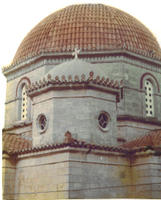
Our hotel (where the woman spoke good English after 10 years in Australia) was on a back street but our rooms on the third floor had a lovely view of the marina and the large church across the street with a quaint steeple with a very loud bell that gonged every half hour. We were awakened by the sound of hammering above our heads at 8 a.m.
Finally we went exploring the island – up a hill to a small church and a view of Athens – even to seeing the Acropolis in the distance and the sea (where the Athenians defeated the Persian fleet ... before we arrived) – then to the ruins of the local temple. We all got along well and had a splendid day.
Back in the town, the wind had whipped up tremendously and the little sailboats and even larger ones were bobbing at their moorings, halyards clanking against swaying masts. We discovered that no car ferry could cross in these heavy seas, so Jon & Dorothea & Meg took the people ferry back. Bijou and I bought food and parked the bus in the most sheltered spot we could find, ate, played scrabble by the light of the lamp post and snuggled to bed by 8 p.m. The wind whipped trees and whistled and rocked the bus, we made love to the rhythm, slept in our arms like infants.
22 October Tuesday Aegina to Athens
We awoke at 8, to find a line of trucks waiting for the ferry. It came on time and we were the last on – after the ride back – the first off. We made our way from Piraeus to Athens and crawled in the traffic making our way back by our simple (printed) map, unreadable street signs and looking at the Acropolis as a landmark (the Parthenon faces exactly East / West).
Somehow we made it back to Jon's flat in Aghia Paraskevi, bought some food and ate it, and spent the rest of the afternoon washing clothes and listening to the wind as it blew our clothes off the roof top wash line.
Jon & Dorothea finally arrived and we went out to yet another new taverna, the Rocky Mountain Oyster Taverna. The Americans living here have not mastered Greek names, so streets and restaurants are known by their characteristics: The Flukes Taverna on Aegina is decorated by fish fins; Pepsi Road is a main drag which has a Pepsi billboard. Democritus Road I did not catch why. As Dorothea said, it is somewhat shameful they have not bothered to learn the language, living in Greece for two years and not learning more than a few phrases; all the Americans here denigrate the locals for their laziness, the silly bureaucratic regulations, their “un-American-ness.”
23 October Wednesday Athens to Korinth to Mikini to Napflion
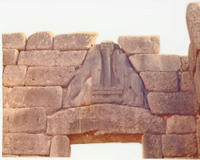 Freedom at last. We picked up our rental car last night, a Bug, and after a false start and detour to obtain our (forged) student cards we were on our way. We made it through Athens along the coast of the Aegean on the other side of Piraeus, ugly with oil refineries and junk yards and beautiful with glistening blue water and winding road through olive orchards. We wound through small towns and over the Korinth Canal – just a very deep ditch – and into ancient Korinth with its lively ruins of the ancient city.
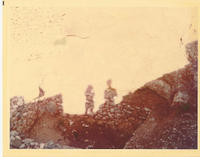 After moaning over the high prices of a few tourist shops, we drove again, through green country to Mikini (Mycenae) and up to magnificent, darkly primitive ruins of the Mycenaean civilization that flourished 800 years before the Parthenon was built. The entire Argolis valley lay below. We continued on to Napflion and ended at a youth hostel which is new, modern, with fine facilities --- and empty. As is the town – more so because there is a football (soccer, of course) game which many locals watch in the tavernas around the town. Summertime the place swings, I’m sure, but now it is like a ghost town, eerily still.
Seems like throughout our trip we either hit big crowds or empty towns. Somewhere there must be a happy medium.
 24 October Thursday Napflion to Epidavrus to Napflion to Tiryns to Argos to Olymbia
It has been a perfect day, filled with wondrous surprises. First, we went to the theater of Epidavrus and picnicked in its stadium. We then visited ancient ruins at Tiryns, as old as the Mycenaean, marveling again at what they had accomplished. On to Argos, still more amazing ruins – Roman on top of Greek and a theater even bigger than the first one. From Argos it was a long upward climb through the Arcadian mountains with the fertile green farmland below. Finally a brief stop in Tripolis and then a tortuous, but breathtakingly beautiful three hour drive to Olymbia.
 The images came fast and dazzling: sun over pine mountains, terraced farms on the mountainside, deep gorges between mountain ridges, all green and autumn orange and yellow. Villages set in steep slopes, its people apparently mountain goat nimble. White washed houses with red tile roofs, churches, bridges, a herdsman, or boy or woman with sheep or goats, horses, mules, donkeys, dogs all rushing or sauntering alongside the road, chickens trying to get to the other side; the sun behind the mountains, the sky darkening blue, the mountains green becoming gray, a river in dusky outline. The road then black and winding, through one-road towns and finally to Olympia, where it was said man’s form was the most perfect and beautiful.
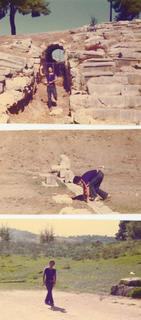
Bijou caught a snapshot of my perfect form as I entered the arena, waving to the adoring crowds, and took my mark on the track and ran The Olympic Track. I won, of course.
25 October Friday Olympia to Patras to Arta & 26 October Saturday Arta to Ionnanina to Metsovon
... A land of contrasts ... picturesque ... breathtaking ... verdant ... West meets East... Travel brochure lingo with which we have been drenched. Clichés to be sure but so often accurate. The superlatives seem to be true and as we bend away from the latest mountain zig, leaving us only able to gush “beautiful ... incredible ... fantastic...” Bijou scarily terrified at my constant “Look at that” while I steer past the incredible, fantastic and beautiful scenery, the verdant mountain slope with the picturesque quaint village houses clinging at breathless angles above the ... verdant farmland ... etc. as our rented VW Bug ticks around the next zag ...
As for the land of contrasts, how about this: as I am writing this we are in Metsovon, a picturesque town (of course—there aren’t any other kind in this travel land) 5000 feet up in the Pindus Mountains in Central Greece. The wind whips around the side of the mountain on which slope our room in a private house clings at a breathtaking angle and we can’t wear enough layers of clothing to keep warm—we have some sweaters and light coats and wear all of them and are still cold. Two days ago we sweated our way across the archeological ruins of the sun drenched Peloponnese.
On Friday we left Olympia and drove to Patras, then cross on the ferry to Arta, stopping only for food, gas and a misadventure over textiles in a small swampy coast town, Etolikan. Arta was up in the hills, reached by coursing more scenic, if not breathtaking (as was the road to Olympia truly b/t) country. Another cold water shave and we hopped to Ionnanina, in the hills, but warm at midday, a bustling city, modern in a provincial way.
We toured a cavern at Perama, picnicked overlooking a lake and continued through mountains on a rocky, winding road, climbing steeply past verdant valley after picturesque village. Finally a last squirmy climb and we were here in Metsovon where the ski season is one month away, where women wear Swiss or German costumes, men wear alpine gear; where Oriental Turkish and Venetian style architecture and Byzantine churches can be found—that’s right, East meets West— and where every hotel in town is full up, and where we lie huddled in a picturesque non-insulated room, our breath taken, incredible-ly cold, our noses a beautiful shade of red.
27 October Sunday Metsovon to Meteora to Trikkala to Lamia
Our weather, which held firm, sunny, even as we climbed to the frigid air of Metsovon, broke. We shivered as we dressed in all our warmest clothes and left our room to greet a cold, rainy morning.
We climbed the slippery rock steps to our car and drove through the village, stopping only to buy a piping hot fresh bread and salami. We carefully threaded through the streets filled with church goers. The road wound back through the mountain still rising snakily through the morning fog. The rain became sleet and coated the windshield of our heaterless car. We munched on the moist hot bread which Bijou kept on her lap for its warmth.
In an hour the road twisted down into another valley and soon the rain eased, though the day continued gray and cold. The view maintined its beauty, though, the fall colors startlingly vivid, saturated under the gray light. We went on and by midday were crossing the plain to the Meteora Rocks. The monastery clings to the tops of the towering pillars arrogantly and independently.
On to Trikkala on a sleepy Sunday afternoon where we bought a long haired wool Flakati rug, which has yet to be made for us—trust and trepidation. Across a flat plain we headed south to Lamia. The town was jumping and we joined the strollers and watched a movie.
28 October Monday “Oxi Day” Lamia to Delfi
It is “Oxi Day” (x pronounced “ch” as in “la chaim”), a national Greek holiday, celebrating the 1825 war of independence against Turkey in which a Greek general when asked to give up said “Oxi, No.” Sort of like the WWII American general, McAulifffe, who answered a German surrender demand during the Battle of the Bulge: “Nuts.”
All during our trip, flags have been draped and signs of celebration appeared. This morning I awoke to sounds of band music from the square. When we got there it was jammed with people around the statue of a soldier. Officials, dignitaries and their wives, a priest and soldiers held a prayer and laid a wreath. A parade began.
The sun once again was warming and we started on our way to Delfi. On the way through mountains we wended through the Pass of Thermopylae and crossed the Plains of Thessaly and onto the Sacred Plain, olive groves stretching across its broad valley between the mountains.
Again, for the umpteenth time the road began to twist upward into mountains, lush green slopes. Finally we crossed into the town of Delfi. We found a room and walked to the museum, crowded with Oxi Day weekend tourists. Its gem, The Charioteer, impressed us as Olympia’s Hermes / Dionysus had not. We coursed the ruins of the treasuries and temples again marveling at the complex richness of what was. We asked the Oracle about our future and kissed to seal a promise of what will be.
29 October Tuesday Delphi to Athens
We awoke to another dreary rainy morning, the type of chilled to the bone days we had better get used to this winter.
 We returned to Athens and Jon’s house as if it were our own, anxious to wash ourselves and our clothes. I was also desirous of reading a newspaper. Though not reliant on my daily dose of news and sports, I do find I miss living without some news. Tonight Jon and I buried ourselves in the last few days’ Stars and Stripes for an hour while Bijou played with Nike, Dorothea's cat.
Picking up political and sports news as rumors or as follow up news stories is somewhat disconcerting. You pick up a Tribune and an article headlined “Former President Nixon Recovering After Surgery” stares at you. This can be quite a shock if you hadn’t heard about his resignation or blood clot. On the sports page you see “Ali May Forestall Retirement To Defend His Championship.” If I hadn’t been lucky enough to conquer the static for a few minutes and get Armed Forces Radio, that would have been indecipherable. It has been three months. But I guess some things do change.
Did they ever find Patty Hearst?
30 October Wednesday Through 6 November Wednesday Athens 30 October: There was a full moon tonight at exactly 2100 hours Athens time.
For the two weeks we have been in Greece I have carefully studied the phases of the moon, my heart quickening as it showed first a sliver, then a crescent, a quarter, a half, then gibbous. Last night watching it rise, almost full fledged and I knew tonight would be the night.
Today while chore-ing in Athens: returning the rental car, changing money— I dropped in at the National Tourist Office and confirmed what I knew: the full moon was tonight and so the Acropolis would be open to allow visitors the monthly pleasure, if cloudless, to trod the stones in the full moon light.
 So we gobbled 3 pizzas and drove downtown. We climbed the hill and arrived at 8 p.m., long after dark, the moon a perfect round silver plate above the sacred hill which the Gods aimed down so its light would bathe the white marble and cast long shadows of the Parthenon’s columns. As we reached the top, we found the entrance gate inexplicably closed. The others shot accusing glances toward me—it was my information relayed from the Ministry of Tourism relied upon.
Dumbfounded I merely pointed up to the moon, which seemed to be grinning mischievously. We scrambled toward the side entrance, still further up the hill. Its light was on, a guard inside. I heaved a sigh. But as we neared, we saw the gate was locked. Dorothea conversed in Greek and came away shaking her head. “He says the full moon is not until 9 p.m.!”
We stared upward, disbelieving but resigned to wait an hour after this latest example of bureaucratic brilliance. When finally let in, it was worth it and quite indescribable.
Meg cavorted over the stones, cartwheeling in the moonlight in the long shadows of the Parthenon. I wonder whether she will remember this distinction later in her life.
We were almost alone on the ferry. Jon’s VW bus was the only vehicle on board. Aegina is one hour or so from Piraeus, thus a busy weekend spot for Athenian tourists. The sky was moody and the air cool without the hidden sun. We strolled along the thoroughfare lined with cafés, restaurants and souvenir shops facing a small marina. We ate some octopus and shrimp with ouzo and found a small hotel for Bijou and myself.
After a walk up winding streets, ogling the old white washed houses with their fascinating styles of shutters and eaves and clean lines, we drove out of the town and found a small taverna open. We had dinner and a couple of liters of retsina and were in a talkative mood. Dorothea warmed up considerably and we ended the evening giggling and joking while talking to one of the owners – feeling far superior to mere tourists.
 21 October Monday Aegina
Our hotel (where the woman spoke good English after 10 years in Australia) was on a back street but our rooms on the third floor had a lovely view of the marina and the large church across the street with a quaint steeple with a very loud bell that gonged every half hour. We were awakened by the sound of hammering above our heads at 8 a.m.
Finally we went exploring the island – up a hill to a small church and a view of Athens – even to seeing the Acropolis in the distance and the sea (where the Athenians defeated the Persian fleet ... before we arrived) – then to the ruins of the local temple. We all got along well and had a splendid day.
Back in the town, the wind had whipped up tremendously and the little sailboats and even larger ones were bobbing at their moorings, halyards clanking against swaying masts. We discovered that no car ferry could cross in these heavy seas, so Jon & Dorothea & Meg took the people ferry back. Bijou and I bought food and parked the bus in the most sheltered spot we could find, ate, played scrabble by the light of the lamp post and snuggled to bed by 8 p.m. The wind whipped trees and whistled and rocked the bus, we made love to the rhythm, slept in our arms like infants.
22 October Tuesday Aegina to Athens
We awoke at 8, to find a line of trucks waiting for the ferry. It came on time and we were the last on – after the ride back – the first off. We made our way from Piraeus to Athens and crawled in the traffic making our way back by our simple (printed) map, unreadable street signs and looking at the Acropolis as a landmark (the Parthenon faces exactly East / West).
Somehow we made it back to Jon's flat in Aghia Paraskevi, bought some food and ate it, and spent the rest of the afternoon washing clothes and listening to the wind as it blew our clothes off the roof top wash line.
Jon & Dorothea finally arrived and we went out to yet another new taverna, the Rocky Mountain Oyster Taverna. The Americans living here have not mastered Greek names, so streets and restaurants are known by their characteristics: The Flukes Taverna on Aegina is decorated by fish fins; Pepsi Road is a main drag which has a Pepsi billboard. Democritus Road I did not catch why. As Dorothea said, it is somewhat shameful they have not bothered to learn the language, living in Greece for two years and not learning more than a few phrases; all the Americans here denigrate the locals for their laziness, the silly bureaucratic regulations, their “un-American-ness.”
23 October Wednesday Athens to Korinth to Mikini to Napflion
 Freedom at last. We picked up our rental car last night, a Bug, and after a false start and detour to obtain our (forged) student cards we were on our way. We made it through Athens along the coast of the Aegean on the other side of Piraeus, ugly with oil refineries and junk yards and beautiful with glistening blue water and winding road through olive orchards. We wound through small towns and over the Korinth Canal – just a very deep ditch – and into ancient Korinth with its lively ruins of the ancient city.
 After moaning over the high prices of a few tourist shops, we drove again, through green country to Mikini (Mycenae) and up to magnificent, darkly primitive ruins of the Mycenaean civilization that flourished 800 years before the Parthenon was built. The entire Argolis valley lay below. We continued on to Napflion and ended at a youth hostel which is new, modern, with fine facilities --- and empty. As is the town – more so because there is a football (soccer, of course) game which many locals watch in the tavernas around the town. Summertime the place swings, I’m sure, but now it is like a ghost town, eerily still.
Seems like throughout our trip we either hit big crowds or empty towns. Somewhere there must be a happy medium.
 24 October Thursday Napflion to Epidavrus to Napflion to Tiryns to Argos to Olymbia
It has been a perfect day, filled with wondrous surprises. First, we went to the theater of Epidavrus and picnicked in its stadium. We then visited ancient ruins at Tiryns, as old as the Mycenaean, marveling again at what they had accomplished. On to Argos, still more amazing ruins – Roman on top of Greek and a theater even bigger than the first one. From Argos it was a long upward climb through the Arcadian mountains with the fertile green farmland below. Finally a brief stop in Tripolis and then a tortuous, but breathtakingly beautiful three hour drive to Olymbia.
 The images came fast and dazzling: sun over pine mountains, terraced farms on the mountainside, deep gorges between mountain ridges, all green and autumn orange and yellow. Villages set in steep slopes, its people apparently mountain goat nimble. White washed houses with red tile roofs, churches, bridges, a herdsman, or boy or woman with sheep or goats, horses, mules, donkeys, dogs all rushing or sauntering alongside the road, chickens trying to get to the other side; the sun behind the mountains, the sky darkening blue, the mountains green becoming gray, a river in dusky outline. The road then black and winding, through one-road towns and finally to Olympia, where it was said man’s form was the most perfect and beautiful.
Bijou caught a snapshot of my perfect form as I entered the arena, waving to the adoring crowds, and took my mark on the track and ran The Olympic Track. I won, of course.
25 October Friday Olympia to Patras to Arta & 26 October Saturday Arta to Ionnanina to Metsovon
... A land of contrasts ... picturesque ... breathtaking ... verdant ... West meets East... Travel brochure lingo with which we have been drenched. Clichés to be sure but so often accurate. The superlatives seem to be true and as we bend away from the latest mountain zig, leaving us only able to gush “beautiful ... incredible ... fantastic...” Bijou scarily terrified at my constant “Look at that” while I steer past the incredible, fantastic and beautiful scenery, the verdant mountain slope with the picturesque quaint village houses clinging at breathless angles above the ... verdant farmland ... etc. as our rented VW Bug ticks around the next zag ...
As for the land of contrasts, how about this: as I am writing this we are in Metsovon, a picturesque town (of course—there aren’t any other kind in this travel land) 5000 feet up in the Pindus Mountains in Central Greece. The wind whips around the side of the mountain on which slope our room in a private house clings at a breathtaking angle and we can’t wear enough layers of clothing to keep warm—we have some sweaters and light coats and wear all of them and are still cold. Two days ago we sweated our way across the archeological ruins of the sun drenched Peloponnese.
On Friday we left Olympia and drove to Patras, then cross on the ferry to Arta, stopping only for food, gas and a misadventure over textiles in a small swampy coast town, Etolikan. Arta was up in the hills, reached by coursing more scenic, if not breathtaking (as was the road to Olympia truly b/t) country. Another cold water shave and we hopped to Ionnanina, in the hills, but warm at midday, a bustling city, modern in a provincial way.
We toured a cavern at Perama, picnicked overlooking a lake and continued through mountains on a rocky, winding road, climbing steeply past verdant valley after picturesque village. Finally a last squirmy climb and we were here in Metsovon where the ski season is one month away, where women wear Swiss or German costumes, men wear alpine gear; where Oriental Turkish and Venetian style architecture and Byzantine churches can be found—that’s right, East meets West— and where every hotel in town is full up, and where we lie huddled in a picturesque non-insulated room, our breath taken, incredible-ly cold, our noses a beautiful shade of red.
27 October Sunday Metsovon to Meteora to Trikkala to Lamia
Our weather, which held firm, sunny, even as we climbed to the frigid air of Metsovon, broke. We shivered as we dressed in all our warmest clothes and left our room to greet a cold, rainy morning.
We climbed the slippery rock steps to our car and drove through the village, stopping only to buy a piping hot fresh bread and salami. We carefully threaded through the streets filled with church goers. The road wound back through the mountain still rising snakily through the morning fog. The rain became sleet and coated the windshield of our heaterless car. We munched on the moist hot bread which Bijou kept on her lap for its warmth.
In an hour the road twisted down into another valley and soon the rain eased, though the day continued gray and cold. The view maintined its beauty, though, the fall colors startlingly vivid, saturated under the gray light. We went on and by midday were crossing the plain to the Meteora Rocks. The monastery clings to the tops of the towering pillars arrogantly and independently.
On to Trikkala on a sleepy Sunday afternoon where we bought a long haired wool Flakati rug, which has yet to be made for us—trust and trepidation. Across a flat plain we headed south to Lamia. The town was jumping and we joined the strollers and watched a movie.
28 October Monday “Oxi Day” Lamia to Delfi
It is “Oxi Day” (x pronounced “ch” as in “la chaim”), a national Greek holiday, celebrating the 1825 war of independence against Turkey in which a Greek general when asked to give up said “Oxi, No.” Sort of like the WWII American general, McAulifffe, who answered a German surrender demand during the Battle of the Bulge: “Nuts.”
All during our trip, flags have been draped and signs of celebration appeared. This morning I awoke to sounds of band music from the square. When we got there it was jammed with people around the statue of a soldier. Officials, dignitaries and their wives, a priest and soldiers held a prayer and laid a wreath. A parade began.
The sun once again was warming and we started on our way to Delfi. On the way through mountains we wended through the Pass of Thermopylae and crossed the Plains of Thessaly and onto the Sacred Plain, olive groves stretching across its broad valley between the mountains.
Again, for the umpteenth time the road began to twist upward into mountains, lush green slopes. Finally we crossed into the town of Delfi. We found a room and walked to the museum, crowded with Oxi Day weekend tourists. Its gem, The Charioteer, impressed us as Olympia’s Hermes / Dionysus had not. We coursed the ruins of the treasuries and temples again marveling at the complex richness of what was. We asked the Oracle about our future and kissed to seal a promise of what will be.
29 October Tuesday Delphi to Athens
We awoke to another dreary rainy morning, the type of chilled to the bone days we had better get used to this winter.
 We returned to Athens and Jon’s house as if it were our own, anxious to wash ourselves and our clothes. I was also desirous of reading a newspaper. Though not reliant on my daily dose of news and sports, I do find I miss living without some news. Tonight Jon and I buried ourselves in the last few days’ Stars and Stripes for an hour while Bijou played with Nike, Dorothea's cat.
Picking up political and sports news as rumors or as follow up news stories is somewhat disconcerting. You pick up a Tribune and an article headlined “Former President Nixon Recovering After Surgery” stares at you. This can be quite a shock if you hadn’t heard about his resignation or blood clot. On the sports page you see “Ali May Forestall Retirement To Defend His Championship.” If I hadn’t been lucky enough to conquer the static for a few minutes and get Armed Forces Radio, that would have been indecipherable. It has been three months. But I guess some things do change.
Did they ever find Patty Hearst?
30 October Wednesday Through 6 November Wednesday Athens 30 October: There was a full moon tonight at exactly 2100 hours Athens time.
For the two weeks we have been in Greece I have carefully studied the phases of the moon, my heart quickening as it showed first a sliver, then a crescent, a quarter, a half, then gibbous. Last night watching it rise, almost full fledged and I knew tonight would be the night.
Today while chore-ing in Athens: returning the rental car, changing money— I dropped in at the National Tourist Office and confirmed what I knew: the full moon was tonight and so the Acropolis would be open to allow visitors the monthly pleasure, if cloudless, to trod the stones in the full moon light.
 So we gobbled 3 pizzas and drove downtown. We climbed the hill and arrived at 8 p.m., long after dark, the moon a perfect round silver plate above the sacred hill which the Gods aimed down so its light would bathe the white marble and cast long shadows of the Parthenon’s columns. As we reached the top, we found the entrance gate inexplicably closed. The others shot accusing glances toward me—it was my information relayed from the Ministry of Tourism relied upon.
Dumbfounded I merely pointed up to the moon, which seemed to be grinning mischievously. We scrambled toward the side entrance, still further up the hill. Its light was on, a guard inside. I heaved a sigh. But as we neared, we saw the gate was locked. Dorothea conversed in Greek and came away shaking her head. “He says the full moon is not until 9 p.m.!”
We stared upward, disbelieving but resigned to wait an hour after this latest example of bureaucratic brilliance. When finally let in, it was worth it and quite indescribable.
Meg cavorted over the stones, cartwheeling in the moonlight in the long shadows of the Parthenon. I wonder whether she will remember this distinction later in her life.
Thursday, September 15, 2005
A Day In My LIfe ... Or ... Why I Kvetch ...
I drive for an hour (listening to the Roberts confirmation hearing) to get to the law office where my client is waiting. When I get there, BC is wearing a bilious face like someone going nowhere on a wobbly carousel.
He sums for me. Our clients have a new version of their story. They were still going to do "massages," but crucial details have been altered. The wits they had promised aren’t there. No phone numbers, no last names.
I hop onto the carousel for a while, but get queasy in a hurry, so I try a little cross-exam, which is another kind of ride, what with the need for interpreters. Like a Jerry Lewis skit, I ask a five word question, and the interpreter rants for ten minutes, then the client answers for another ten and the interpreter translates: “She says, ‘No.’”
In the end, I sum up the defense, speaking slowly for translation. “So you were wearing sleep clothes? ... waiting for your boyfriend? ... You got a call from a guy you didn’t know? ... who sent a taxi to pick you up? ... to take you someplace to meet a man? ... to get money for a massage? ... and you didn’t change? ... and two condoms were in your pocket? ... and K-Y jelly?
Even the interpreter laughs. She translates the client’s answer: “Would it be better if I said something else?”
BC lectures on ethics and the role of defense lawyers, sounding like Judge Roberts explaining stare decisis to senators from Kansas. He goes on for about ten minutes before telling the interpreters to translate.
This time I laugh. Trial is supposed to start on Monday.
BC and I go out for dim sum and remind each other of nightmares --- hearing client’s testifying to completely new stories on the witness stand. When it happened to me the first time, I had looked down at my notes, found nothing there to help me. So I had done what DA’s always did with their witnesses, “What happened next?” I kept asking, trying to sound as if I knew the answers, ignoring the sweat dribbling down my spine.
I drive to the jail, hand in two request slips. AV comes first. He’s pro per, facing the death penalty and I’ve been appointed as advisory counsel. I don’t like the role - my name on the docket that judges can point to as an excuse to affirm the sentence. I see my real job as trying to persuade him to go back to his previous lawyers. He fired them because their advice was daunting.
He’s worked a week on a motion to continue that a lawyer would do in a half hour. I ask him if he’s read the discovery material I copied for him. He nods.
“Have you thought about your defense?”
“Yes,” with a very serious face. “I didn’t do it.” Then an embarrassed smile.
“How are you going to explain your DNA at the scene?”
“I’m working on that.”
“And your taped confession?”
“Are you on my team?”
I explain that I’m there to advise him, not make him feel good.
“I heard you say that I’m sticking a needle in my arm.”
“Yeah, I told your sister that in my opinion anyone defending himself on a capital case might as well stick the lethal injection in his own arm, because he’s committing suicide.”
“I need somebody on my team.”
“Not if your team is gonna be executed.”
He smiles as if nothing more needs be said. But it does. “If you want to ask the judge for a different advisory counsel, that’s okay with me,” I say.
He’s sullen now. “Maybe I will. I’ll call you.”
“Make it collect.”
I give him more discovery he won’t understand and go on to the next client who is sitting in another row.
The client called me so I can put more money on his books. I’ve been doing that each month for about a year. He's worried; one of the three psych experts I’ve retained got him scared by asking what his defense is.
“We’ve talked about this a lot,” I remind him. “You confessed to both murders - on tape. On each, you began by denying the crimes, but eventually admitted when you were confronted with the evidence by the cops.”
“I didn’t know they were taping. They tricked me.”
“Did you tell them the truth?”
“Yeah.”
“So they tricked you into telling the truth?”
“Yeah.”
Mercy is what I need now, and finally it comes - a stay of execution. The desk deputy calls out, “Lock down is now in effect. The attorney room will be cleared.”
The client understands. I’ll go and put the money on his books and we’ll talk the next time. It’s an amicable parting, my first of the day.
I walk across the street to the twin towers and up the stairs to the property area. I curse because there is a long line of mostly women carrying babies there to deposit money for their jailed loved ones. I stand in the back of the line and peer to the front. All three windows are dark.
“Where’s the lady who takes the money?”
“Computers are down.”
“Swell.”
I can go home now and prepare for the trial set to begin tomorrow. In the car, I listen to Judge Roberts explain how lawyers can advocate without believing as their clients do.
My cell phone rings. The court clerk. The trial now in progress is going long, my case will be delayed. Another stay of execution. I can sleep tonight - if I don’t think about today.
Saturday, September 03, 2005
The Gulf Wars
Q: What is the president's position on Roe v. Wade?
A: He really doesn't care how people get out of New Orleans.
Blogging about current events is not necessarily my goal. But this is too much. My tendencies to pun and to find connections among disparate events flood beyond my control in times like these.
I can’t avoid seeing deep meaning in the “Gulfs” which are in the headlines. I see too many of them. We have been at war in The Persian Gulf for more than a decade. Now nature dumped The Gulf of Mexico into the Mississippi Delta, exposing more gulfs — like the chasm between middle class Americans and the permanent underclass of African Americans, Hispanics and other poor; and the ever widening gulf between our government leaders and the people. We are losing all the Gulf Wars. Maybe it foretells a sea change in American politics.
David Brooks, the conservative New York Times columnist, sounded Friday night like an alarmist Socialist on PBS’s “Jim Lehrer Report::”
“...What you get is meteorological storms and then political storms because in moments of extremis people see who's up and who's down, who's at fault and who is suffering. So, for example in 1897 there was the famous Johnstown Flood, a pond owned by millionaires including Andrew Carnegie flooded the town of Johnstown. The public anger over that helped spawn the Progressive Movement.
“Then in 1927 you had the great Mississippi Flood, which flooded New Orleans. And there you have first of all, great demand for the government to get involved in disaster relief which had not happened much before then. And that helped lead the way to the New Deal. The town fathers flooded some of the poorer and middle class areas to relieve some of the pressure on the rest of the city and then reneged on their promises for compensation for the people who had their homes destroyed. The anger over that helped lead to the rise of Huey Long, the populist governor.
“So in moments of extremis, people see the power inequalities, the poor suffering, the rich benefitting and then they react. And so you get these political reactions.
“... I think it is a huge reaction we are about to see. I mean, first of all, they violated the social fabric, ...in the moments of crisis you take care of the poor first. That didn't happen; it's like leaving wounded on the battlefield.
“In 9/11 you had a great surge of public confidence. Now I think we are going to see a great decline in public confidence in our institutions....”
In his NY Times column, Sept. 1, 2005, titled “The Storm After The Storm,” Brooks concluded:
“What's happening in New Orleans and Mississippi today is a human tragedy. But take a close look at the people you see wandering, devastated, around New Orleans: they are predominantly black and poor. The political disturbances are still to come.”
When I look I see President Bush offering prayer and private charity as the solutions to the stench. No doubt our President, a man of deep religious faith, will call the event an “act of God,” another Biblical Flood, perhaps even privately think it retribution for sins - not his sins, of course.
Thursday, September 01, 2005
What's It All About?
 The boy looks the same, hasn’t changed at all since I first saw him — what was it, 17, 18 years ago — walking toward me in the same attorney room at the county jail.
Back then I had the usual creeping sensation up my neck, the familiar shock to be suppressed when meeting a new client who had killed and who might well be condemned to die on my watch.
He was barely 18 when I first introduced myself to him as his public defender. He was just a skinny, shy, Chinese kid with glasses, who looked about 14. His face was hairless and already jailhouse waxy. His grasp of English was so elemental that he seemed younger still. At the arraignment, the hard-nosed head deputy D.A., Dino Fulgoni, had cracked, “Jeez, it’s gonna take a real S.O.B. to put this kid in the gas chamber.” They tried their best to do it, too.
He smiles as he sees me and walks toward my stall. I move out of the room onto a row stool so I won’t have glass between us. He’s doing okay, and I tell him so am I. He says I haven’t changed, but I correct him. I know my own face, my gray hair, I feel my age. I’m 62, he’s 37 years old now. A man, but he still looks like a kid. There is no hardness to his face, nor in his eyes. His English isn’t much different than it was back then, and his manner is just as respectful, diffident, polite.
He’d cooperated, confessed 4 times. After he’d shot the two men, after the car chase, after the car and he’d been shot full of holes, after his companions had been killed. He’d been taken to the e.r., gave a “dying declaration” before surgery. Confessed again to a faulty micro recorder and then again to help out the embarrassed interrogator, who was so grateful that he felt sorry for the kid who’d killed two cops. A couple of days later he confessed again to an F.B.I. agent, who didn’t feel sorry for him and did his best to finish him off.
The scars are still there, on his forearm, his neck, and his jaw where the bullet went through his face. He’s been to Pelican Bay, The Shoe for 10 months, Calipatria, Corcoran, Susanville - High Desert. He’s worked in the kitchen, then as a barber. He’s learned how to avoid trouble, but its hard in Level 4 institutions. “There’s a lot of trouble going on,” he says with his characteristic understatement, a little half-smile, mostly keeping the joke to himself, a bit embarrassed that he made one.
For his first 18 years, he’d known his grandpa’s home in Taiwan, a restaurant kitchen in Kansas City, his stepdad’s home in Monterey Park. He was used to keeping a low profile, keeping his eyes averted. He’d spent his childhood that way, the family’s forgotten kid, who never asked for anything.
He tells me his grandfather - the one who’d raised him after his father and mother had left him (and each other) for the U.S. - died. That was hard. He hears from his sister, his mom, his dad. His dad, whose been very ill, came to visit him now in county. They get along better now, but don’t say much to each other. Everyone asks if he needs anything, but he tells them he doesn’t, thinks “they ask to be polite.”
I tell him, “Hey, let them help you. It’ll help them more to know they can do a little.” He nods, but I don’t think he will. I ask him the big question, the reason I’m there after so many years. “Was it worth it? Are you glad I saved your life so you could spend the rest of it behind bars?”
He hesitates, been thinking about it, too, I think, maybe a lot more than I have. “I don’t want to depress you,” he says, ever the considerate kid. “But I think maybe I wish not.”
I try to say something profound and uplifting about hope and the future. He sees the look on my face, lets me off the hook. “Maybe I’m depressed. Here, I see my family and it makes me sad and ashamed.” There’s a bit of feeling in his eyes behind his glasses. We’re both embarrassed and I didn’t come to make him feel sad.
We talk about other things, how maybe I can help a little now. My neck and back are hurting after an hour. I stand up, extend my hand. He shakes it with a little smile. He thanks me “for everything.”
Subscribe to:
Posts (Atom)


