Stat Counter


View My Stats

Monday, August 29, 2005

What goes around ... keeps going around ...

I don’t believe in Kharma. Coincidence, sure. And notions about evil houses - that's for Stephen King. But then again, listen to this one.

It’s around 1983 and we’re ready to sign the escrow papers to the new house, our 3rd in around 10 years after we “settled down.” We’re living in Stu City, a rare LA / Valley walking ‘hood - S. of the B’vard, almost not even TheValley. Then the baby comes and so do cars, screeching ‘round the corner and, like comets once a year or so end up in our front yard. Two fences later, we look to move. It’s okay, Bijou’s done what she can with the place: she’s like a mad nomad decorator - takes about 4 years to finish. Then its time for the next move, next project.

So we look-y-loo with brokers, and after seeing every house listed on the west coast, find a kid friendly place: pool, bigger back yard, most of all quiet, no traffic. Bijou’s excited, sees “possibilities” despite the painted peacock, stone planter with plastic flowers, red carpets. Mostly, I see no cars careening onto the lawn, imagine my kid on a bike, and playing catch in the road.

So here we are. Inspections done, loans approved. Ready to sign and move in asap. “Uh, there is one little item,” the broker mumbles. “A small disclosure.” “Oh? What, like earthquake damage?” “Not exactly. See, there was a murder in the house.” Silence.

Okay, I’m a public defender at the time - always taking my work home with me, but this is ridiculous. I pack up. Bijou huddles, "at least check it out. It might not be so bad." Okay, I “investigate,” make calls. Here’s what I find.

The lady’s bloody body is found near the planter by her adopted son, who’s arrested for it. Police don’t believe he found her that way - he’s 17, druggie, needs cash. I talk to the I/O, the DA, the defense lawyer. He’s going down for at least a 2nd, I’m told. Maybe a 1st, there’s money missing.

So I’m thinking, so much for the quiet street theory. Drunk drivers on the lawn beat dope fiends in the bedroom any night. But Bijou really really likes the place. We’re doing everything over anyway. The crime’s solved, right?

Slow fade to about 17 years later and I’m sitting in my office and I get a call from a PI. He’s working on a habeas for the son, who’s been in all this time. He has one question: “Did you ever tell the I/O that money was found in the attic?”

This is the first time I’ve heard this question, but not the last. A couple of years later I get a call from LAPD, Internal Affairs. A couple more years and the LA Times want to know. Then I get a visit from a different IA guy and a call from the DA who tried the case. They all have a lot of questions about the issue, and they don’t tell me everything they know — see, for once, I’m not the advocate, only a “witness” and they don’t tell witnesses what they know.

I tell them all the same thing. Over the years, we had a lot of work done in the house, including the roof. Bijou died in April, ‘92, after sixteen agonizing and terrifying months of illness. I moved away in ‘95. I don’t remember ever finding any money in the attic, or being told by Bijou that workmen found any, or telling the I/O that any money was found. Considering my experience I think I would remember if any of that happened. So I don’t think it did.

My interrogators don’t tell me all they know, but over time I piece together some details. The motive of the killing was money, and some money was “missing” from the lady’s purse. Around $150. The son denied stealing it, and it wasn’t found on him when the cops came. He was convicted, sentenced to 15 to life and when he came up for parole, the I/O sent letters to the Board. In one letter, he said that he was told by the new owners of the house that workmen had found the money in the attic, which is where he believed the son had hidden it before calling. More evidence, he points out, to counter continuing protestations of innocence.

Now, I begin to wonder. Still don’t remember such a conversation and still can’t imagine I would forget that. Except for one thing. If all this happened while Bijou was going through her hell. There’s lots of things I can’t remember during that nightmare period, whole days went by in a blur, and events are jumbled in my memory. It was a dark time when we were spiraling into an abyss.

And wouldn’t the cop’s memory be better than mine? I can’t call him a liar, just that I don’t remember it. Still ...

So now the LA Times article appears. And there’s plenty of details I didn’t know. The time sequence of the I/O’s letters to the Board suggest that the supposed “conversation” about the money happened between late in ‘91 and April, ‘92. I don’t think Bijou was in any condition at that time to have been casually conversing with neighbors and I don’t remember having any work done at that time.

Then they report a shocker. A notation of an inventory of the contents of the purse found near the body ... it includes around $150 in cash.

And there’s more. There was another suspect, a friend of the son. A phone number was dialed from within the house that might have connected this other guy, and a second person’s shoeprint was found, now connected by DNA to a second person. And an I/A investigator apparently had his own doubts. So does the DA who got the conviction. The I/O has now “retired,” if not under fire, at least amid mounting doubts by many concerned with the case that the right person was convicted.

And now, apparently, the judge hearing the habeas petition has questions. So do I. Two women died tragically in that house, and the mysteries continue.

Monday, August 22, 2005

"How can you defend those people?"

I am a criminal defense lawyer. I have been asked that question for thirty-four years. Each time I answered it, I had to think about it. Now, I am going to give the definitive answer.

For my first twenty years of lawyering, I was a public defender in L.A. When I entered private criminal defense practice, fewer people asked the question, and there is a subtly different tone to those who still do. Obviously, some people now give their own answer before they ask it:

"For the money."

Their perspective is revealed by a knowing and cynical leer. For these questioners, I sometimes wink back, rather than launch into the muddy waters of self-justification.

Others accompany the question with an unstated corollary:

"... when you could make more money with less aggravation in civil law?"

This form of the question is most often asked by civil lawyers, their wives, or doctors. It was often asked by my relatives, after talking with civil lawyers or their wives. For these questioners (including my relatives), my answer is:

"I enjoy the excitement and the money is enough for me."

Or sometimes I wisecrack:

"Which people?"

You see, I defend petty thieves, prostitutes, drug users, kids in trouble, and forgers. No one ever wants to know how I can defend these people. I also defend rapists, child molesters, drunk driver/killers, multiple murderers. These are the people everyone is curious about.

That leads me to answer that the more serious crimes provide the greater degree of excitement and challenge.

If that does not satisfy, I drag out the first of my "doctor analogies:"

A doctor's greatest aspiration should be to treat the most seriously ill patient: the greater the risk to life, the greater the skill required, the greater the challenge and the greater the satisfaction when you do your job right.

If you're serious about your profession -- and if I were ill, I would want the doctor who is most serious -- you should aspire to the greatest challenge. If I were a doctor, I would want to be a brain surgeon rather than a dermatologist.

When I defend in a capital case, I am like a doctor whose patient has a life-threatening illness. If I save the life, I am doing the greatest good my profession has to offer -- even if that life I save is one which many may say is not worth saving.

The analogy also works with the corollary common questions:

"How can you defend someone who you know is guilty?"

My answer:

If I were a doctor with a terminally ill patient, I would not make judgments on the worthiness of the life I was trying to save.

Next question:

"How can you sleep with the heavy responsibility of a capital case?"

Same analogy, same answer:

A doctor learns to detach himself from the weight of his life and death duty; he relies on his preparation, his skill, his conscientiousness. If the patient dies, he wants to be sure he did everything in his power to prevent or forestall it; if he has, he sleeps -- perhaps fitfully at first, but he sleeps and awakes to the next case.

The answer, I admit, is not wholly satisfactory to me. The analogy is not exact. The law deals with moral guilt as its subject matter; medicine does not. But the answer satisfies most people. Once a doctor caught the problem.

For him, I had a question:

"Suppose you were asked to treat a death row inmate, a mass murderer who was scheduled to die; would you use your best efforts to save him?"

The doctor smiled and said, "I wouldn't recommend long-term treatment."

I have not always answered the question so straightforwardly. At first, in the flush of righteous belief that I was fighting The Good Fight for The Constitution and The Bill of Rights, I was offended.

I answered:

"How can I not defend these people?"

In the Sixties, when I began, this answer made me something of a hero in my circle.

Later, while my back was turned, my circle dissolved. My acquaintances -- who had been quickly "radicalized" in the Sixties -- just as quickly became "centralized" in the Seventies and "neutralized" in the Eighties. They became horrified by crimes -- first, by rape when their feminist consciences were raised; then by child molestation; then by "mass murderers" and "serial killers"; now by drug dealers -- forgetting their Sixties poses, a result I presume of all the dope they smoked back then.

When I seemed not to have moved from "the Sixties mentality," the renewed question, now became more strident:

"How can you still defend those people?"

I see now that my seeming unreconstructed liberalism made my old friends squirm. Sensing that, my answers became defensive.

I joked about it, mumbled about keeping the system honest, focused on my distaste for `hustling for a buck' in private practice, and later on, talked vaguely about the security of my county paycheck and eventual early retirement. These were acceptable answers.

But not true. In truth, I had moved a long way from the righteousness of my youth, into a new righteousness of middle age. As a public defender, I began to see the dangers of false liberalism. I had seen liberal judges pay lip service to the law, find my clients guilty on less than convincing evidence and then "not hurt them" in sentencing.

I became a true “conservative.”

The liberal trusts in the benign power of government to restrain the individual for the common good. He deals in big numbers. If a few individuals must be sacrificed for the good of the many, so be it.

The true conservative is skeptical of governmental power over the individual and seeks to restrain its use. The most power a government wields, short of the ability to wage war, is the police power to incarcerate and execute individuals. I fight for the rights of the individual against the power of the government. That makes me a conservative.

In the 70's, when feminists and their fellow travelers, reading accounts of rape trials and TV "docudramas", attacked rape laws which, in their view made it too difficult to convict rapists, they were uneasy when I reminded them about the lesson of history, as reflected in such “right-thinking” morality tales as "To Kill a Mockingbird". Their response: "That was about a Black guy in the South." My liberal friends forgot that such laws so easily led to abuse.

I still believe that it is better to acquit many guilty people than to wrongly convict one innocent person. No one else believes this anymore.

When an increasing crime rate brought cries for longer sentences, reinstatement of the death penalty, elimination of "technicalities" such as constitutional rights and defenses, no one wanted to hear my answer:

It is dangerous to urge both more harsh sentences and easier convictions. The more severe the sentence, the more certain should be the system of proving guilt. If you are going to put someone in jail and throw away the key, it should not be done on the uncorroborated claim of one witness, which history has shown us is unreliable.

Don't get me wrong. I feel the victim's rage. I have been a father, a husband, a homeowner. I worry about rape, child molestation, burglary. I would kill to defend my home.

I believe that some people deserve to die for their crimes.

But when asked about the death penalty, I cannot answer glibly. Most people don't like my answer; it is not what they want to hear. It is not simple. They expect me to say I am opposed to it. I am, but not for the reasons they think; not for abstract reasons.

I repeat: I believe that some people deserve to die for their crimes.

But I have seen the way the system works and conclude that it is fatally flawed. I have watched it, studied it, participated in it for more than twenty years. The defect is basic:

It does not rationally distinguish between people who deserve to die from those who do not.

While my erstwhile liberal acquaintances, like everyone else, are untroubled by this, I can't live with it. I find that people do not care about that answer. It disturbs them. They want their issues chopped with a butcher knife, not carved with a scalpel. They are angry and anger compels stupidity.

Monday, August 15, 2005

My Uncle Sammy

I guess every family has its mysteries. We had a big one. I mean a big family. And to a kid there were a lot of mysteries. For example, my father’s dad was called “Harry” (who lived with “Aunt Ida”); and so was my mom’s brother Harry (whose wife was “Aunt Hanna”), and her father, “Harry” lived with “Aunt Laura,” but she also had a Papa Hymie who lived with “Aunt Ethel.” We had an “Aunt Ida” who sometimes lived with us.

It was complicated. But a kid picks up clues during family gatherings where stories are re-told. Hints about dramas and comedies emerge. Some names you hear whispered with different emotions that a kid has a harder time with, a choked tear. "Sammy" was one of those. He was never at the family gatherings, not one of the pinchers of cheeks. My mother, who was the keeper of family lore, talked most about him, her brother-in-law who “died in the war.”

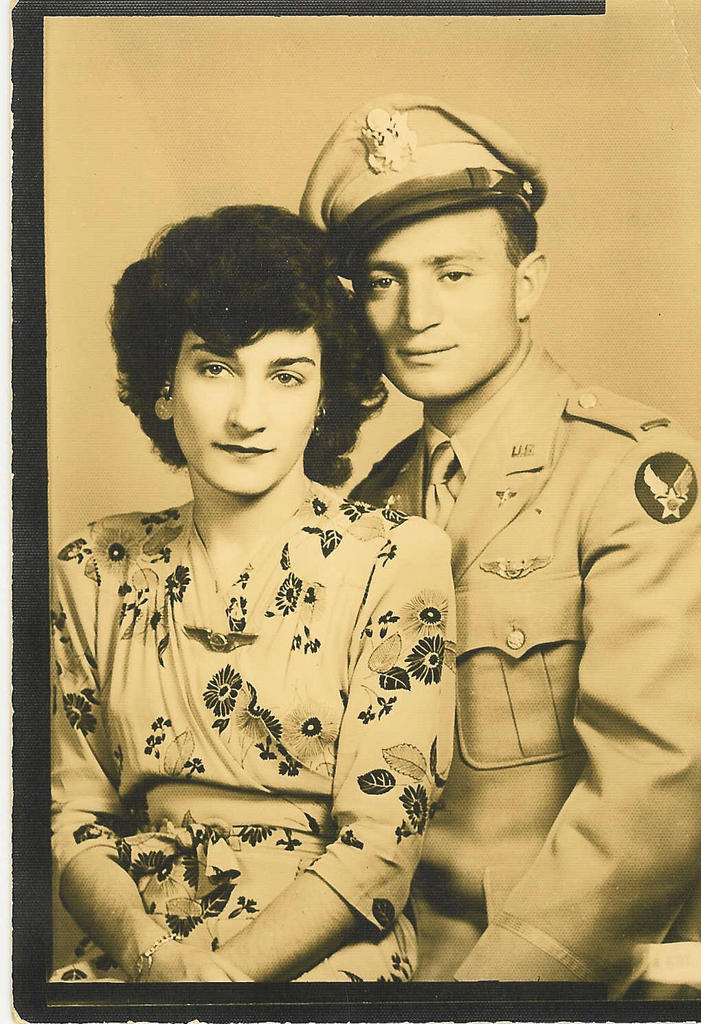
This phrase stuck with me, a kid raised on TV war movies. We had some snapshots and some “effects” that were all there was of “Sammy.” A Purple Heart, silver wings pin, lieutenant’s bar shoulder pin. A kid’s curiosity about war led to questions and I pieced together a story.

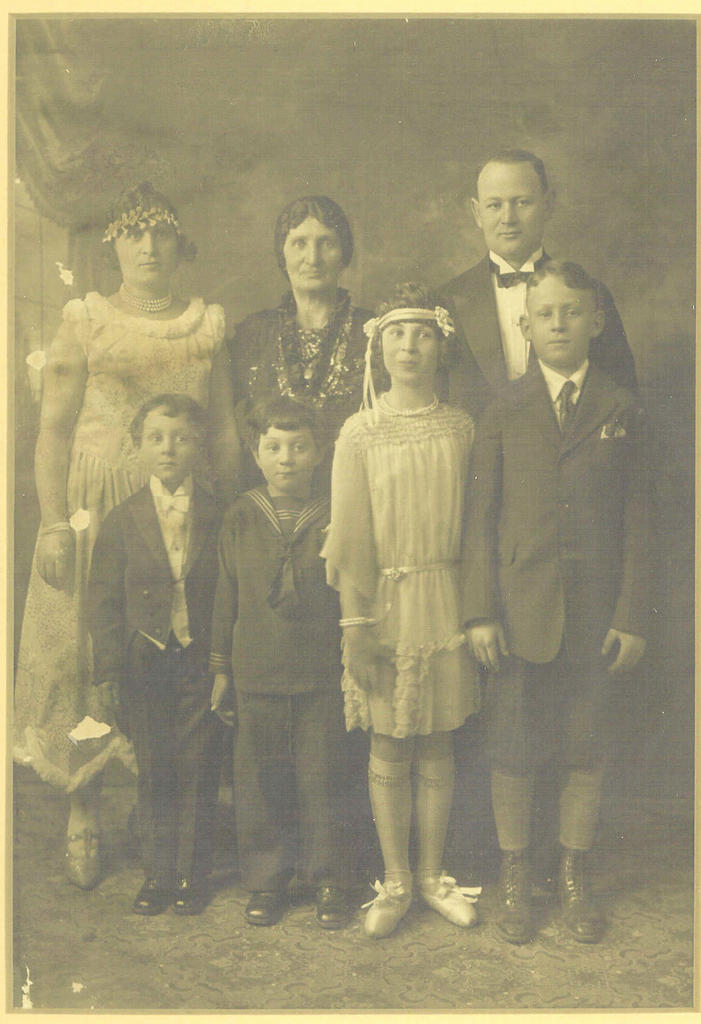
He was the fourth of six kids. Alex (in the suit), Edna (the ballet dancer), Milton and Sam. Two more came later (Alvin and Fran). Milt and Sam wanted to be doctors, "experimented" on unfortunate stray cats in their basement "lab" which included a chemistry kit, with which they also stunk up the neighborhood.

Sam graduated college but World War II interrupted his plans for medical school. He enlisted in the Army Air Corps. He wanted to be a flyer, but was declared too short. With his chemistry degree, he was assigned to the quartermaster corps, the cushiest duty possible. So, of course, when the height limit was lowered because of the increasing need for flyers, he asked to be transferred to flight school.

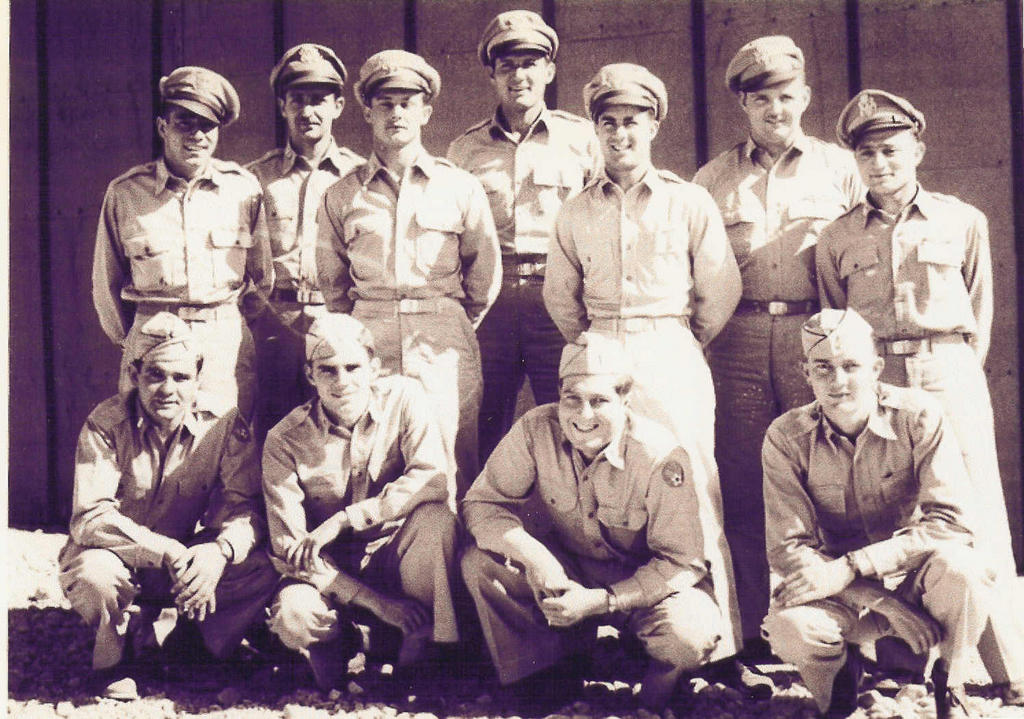
Lieutenant Samuel Borenstein became a navigator / bombadier on B-24's. He came home on leave and spent time with his girlfriend, Gerry. He took my brother, then 8 or 9, on the parachute jump in Coney Island, near where we lived. And then he went “overseas” and, in the specific words I remember, “was shot down over the Bay Of Biscay” and was reported “missing in action and presumed dead.” Gerry remained close to our family for several years but eventually drifted away into her own life.

And that was all I knew.

Fifty years later, I found the old photos in a box and got the idea to try the internet. Sent a message in a bottle with the few facts I had from stories and notes on snapshots “Idaho” “Bay of Biscay.” It didn’t take long. A guy named Don Olds, a veteran who was keeper of the flame about such things, answered me with far more than I could have dreamed.

“Received your email pertaining to your uncle Samuel Borenstein. I do have some material covering his last flight 27 Mar 44. I have the MACR (Missing Air Crew Report) from the aircraft he was aboard when shot down. I may have some other papers as well. He was in the 733rd Squadron of the 453rd Bomb Group stationed at Old Buckingham, Norfolk County, England. The 453rd did their early training at Gower Field in Idaho. So I’m sure we’re talking about the same man.

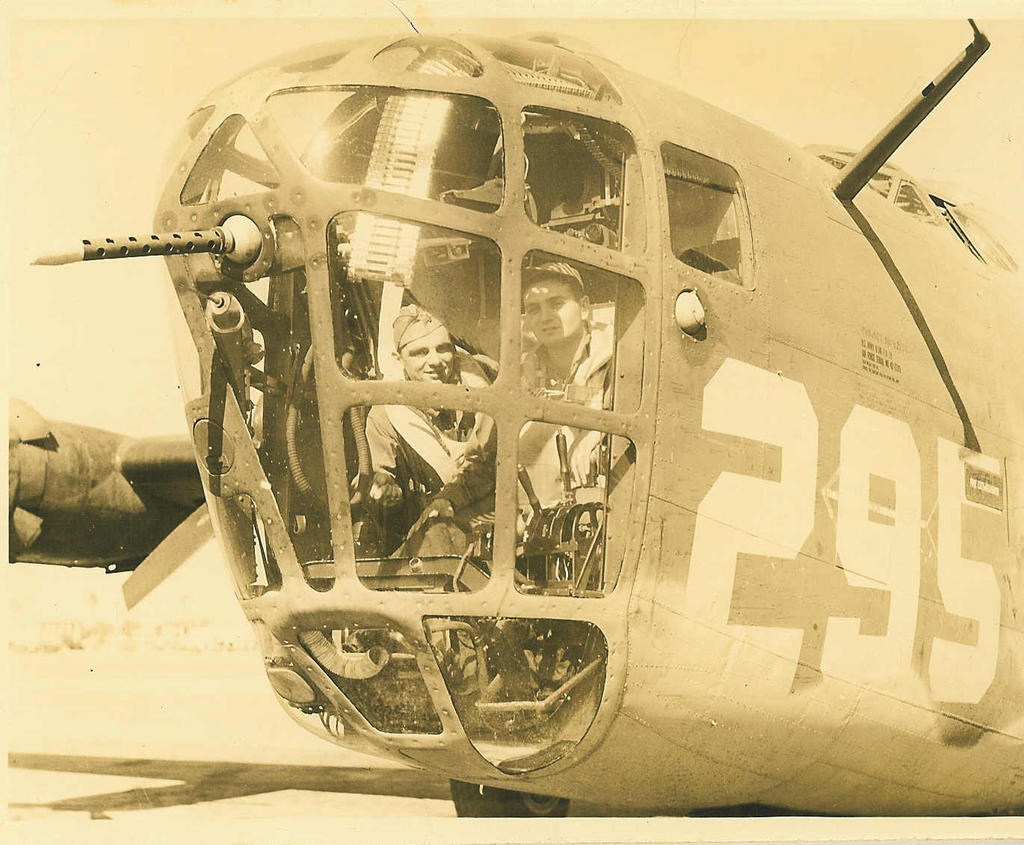
“Your uncle was a member of a B-24 named “Cabin In The Sky” which was piloted by Lt. Alvin Lien. On this particular mission the 733rd Sq. Commanding Officer Major Curtis Cofield was the Command Pilot and the plane was hit by flak and broke into flames and went into the Bay of Biscay. Unfortunately there were no survivors.

"The 433rd had four squadrons, 732nd, 733rd, 734th, 735th. Your uncle was designated as Command Navigator for this mission. The plane and crew were from the 735th, and apparently your uncle was assigned to this mission as a ‘one time thing.’ Being this plane was the Lead Plane in the entire group formation of four squadrons speaks well of the confidence Group Headquarters had in his ability to lead.

“... I have a good picture of ‘Cabin In The Sky’ in flight on the day it was shot down. It is unusual to have such a view of a plane with the waist gunner clearly visible in the window that would soon be blown out of the sky killing eleven men.”

I was amazed and immediately answered back, requesting copies of the photos. Mr. Olds not only sent me the photos, but also many documents, which shocked me. The “MACR” contains eyewitness statements from other crews. Some saw “eight or nine chutes” open after the plane was hit. Might Sam have escaped? Other reports showed that the Army Air Corps tried to trace the fate of the crew.

On 28 March 1945, the chief of “Casualty Branch” filed a report stating that “... nine parachutes were seen to open ... five, who landed in the water, were picked up immediately, presumably by enemy surface craft. Five other crew members have been reported as KIA.” None of the crew had turned up in POW files.

Then, in 1947, a report from “Headquarters, American Graves Registration Command.” Sam and four others are listed as the “missing” subjects.

“SYNOPSIS OF CASE: The above were part of a crew of 11 men A/C #42-6744, which, on 27 March 1944 participated in a bombing mission to Pau, France. At a point over the Bay of Biscay at coordinates 46° 3' N/01° 29'E the subject plane received extensive flak damage and crashed in flames into the sea approximately five miles from shore. Several parachutes were seen. The enemy recovered remains of S/Sgt. Clinton W. CALDWELL, but after all papers were recovered from his clothes, the remains were interred at sea. The remains of crew members LIEN, WATSON, COFIELD, WARD, KAPLAN and LAYSER washed ashore at places adjacent to La Rochelle, France, and are now interred in the USMC Champigneul. A field investigation conducted for the recovery of the remains of the unaccounted for crew members proved negative. In view of the above and the time that has elapsed since the missing flyers have neither been seen or heard from, it can be concluded that they were lost at sea.”

I received another, final note from Mr. Olds. “I remembered the American Cemetary at Cambridge, England and the fact that your Uncle Samuel is indeed honored there. Enclosed is a list of 453rd men who are buried there. Also, there is a ten foot wall running the length of the cemetery with a small chapel at the end of the wall. Into this wall the names of those whose bodies were never recovered are carved. It is called “Wall Of Missing.” On this list the grave location or WOM notation. Didn’t know if you knew this existed. It is a beautiful place and very serene.”

I showed the results at a family gathering. My mom was tearful, and Aunt Fran was touched. He was the first of her now dead four brothers to have gone away.

Links: American Cemetery Cambridge
453rd Bomb Group (H)

Sunday, August 14, 2005

Bijou at 60

When a person is murdered, the victim’s family is luckier than those whose deaths can’t be blamed on anyone. In a capital trial, the “impact” of the murder on loved ones can be used to support a death sentence for the culprit. In other than capital killings, victims get to speak their hearts at sentencing. Even in civil trials, deaths caused by negligence can be vindicated by money judgments.

Any sort of vengeance can be satisfying, I suppose, and provide a form of “closure,” which is one of the buzzwords of our society, more sought after than “love.”

If the person who died caused her own death by self-destructiveness or negligence or unnecessary risk taking, there is some explanation for the event and therefore some symmetry. And when someone dies in old age after a completed life there is acceptance.

All of that is denied when there is no one to blame for a “premature” death caused, say, by an insidious incurable illness.

When someone dies that way, there is nothing to do but feel lousy. Family and friends, mostly out of guilt because they are alive, promise never to forget.

We “celebrate” the lost life, the good times, the silly youthful girl, the wife, mom, friend, daughter, sister, the soulmate.

We remember hr laughter, her capacity to make us laugh ... and ... feel loved. We remember her courage in the face of misery, joke about her love for food, her joie de vivre,
and the way she had of fun at her own cost, and we miss her dreadfully because of the huge hole in our lives that her absence leaves.

For a while we keep our promise, but life is such that we eventually do forget, at least most of the time. We keep the pictures around the house, but don't look at them often anymore. They are part of the furnishings, taken for granted. That each was a moment, a precious instant now gone forever is too painful a thought to dwell on.

I guess it is “healthy” and necessary not to dwell on that kind of pain.

Over time, we think about her less and less. The reality of her existence begins to fade, and remains out of our thoughts for long chunks of time. We forget the way her voice sounded when she laughed or cried, how she looked in the morning or the fragrance of her hair.

We find other ways to laugh, and others who might help us forget. Eventually, the time may come when we find that if someone reminds us of her, it is slightly embarrassing, makes us feel faintly uneasy. And one day she may cease to exist, even in memory, unless strenuous conscious efforts are made to recall the fact that she did live and affected our lives.

The cruel fact is that fame insures immortality for only a few, while most lives are forgotten, even those lives who touched many other lives. The dead live only sporadically in the memories of people who loved them, but when these few die, will it be as if they never lived at all?

Religions tease us with the myth that the dying person’s ‘spirit’ lives on — in heaven, or returning in another form, as part of the "earth" or even in a new living being.

Recurring wisps of movies offer wish fulfillment: ghosts ... dreams ... fantasies of lovers returning to help the living. But you have to be soft headed and hopelessly sentimental to believe such things.
And, really, none of it really helps very much.

She used to tell her students that life isn't fair.

She was right. It goes by so fast.


She was a seven year old refugee lost in l'ecole ... and then an adored teacher.

A lonely "displaced person" became an awkward, lonely girl ... moving from Russia, then to France, and then to L.A., each time feeling different from the others and not understanding enough, not feeling smart enough or pretty enough or good enough ...
feeliing too tall, too Jewish, too Polish, or was it French, or Russian?

She once wrote to me: "I have always felt an outsider. All my life I have searched to fit in..."

But when she began to travel on her own, she began to find what she was looking for: freedom ... a sense of excitement in discovering ... what? ... her power .... taking risks ... seeking adventure ...
... and her independent spirit ... and some found her ... and that was ... well, exciting, too.

She wrote: "... Traveling alone has taught me —first and most obvious—that I can rely on myself—a fact I suspected but was not sure of ..."

She made her mistakes without regret ... chose her life ... then saved mine by taking me along . She took me to places I never dreamed of ... showed me a world I would never have dared to risk alone. We traveled together and she held my hand and pushed me toward life against my timid judgment

... and then she was gone...


She was born into this world on this date sixty years ago and has been out of it for thirteen.

... how can that be?


Je t'aime toujours, Bijou.


These and other memories of Bijou will be posted on flickr.

Saturday, August 06, 2005

Adventures In Crime / Cuddle Or Die

More proof that unprotected sex is dangerous business ... even after marriage.

LA Times, Friday, Aug. 5, 2005:

Florida
"A man who got angry with his wife because she wanted to cuddle after sex when what he really wanted to do was watch sports on television was sentenced to death in Panama City for killing her with a claw hammer.

"[The judge said that] the brutality of the crime outweighed any mental problems [the defendant] may have had. '[He] had struck his wife approximately 70 individual blows after spending a happy interlude with her,' the judge said. 'Her desire to cuddle did not justify the extremely violent, brutal response by the defendant.'"

Oops! Award: 8 eyewits proved wrong. Innocent man freed after 26 years. So sorry!

L.A. Times Friday, Aug. 5, 2005, p.A-16, reported that Luis Diaz, described in the story as "a Cuban born fry cook," who had been convicted in 1980 of 7 rapes has now been released based on a combination of recanted identifications by victims and DNA evidence pursued by Barry Scheck and The Innocence Project.

In the Miami area between 1977 and 1979, there were 25 rapes by the so-called "Bird Road Rapist." A spokesman for the state attorney's office stated that "it was fruitless to second guess the processes that had put Diaz behind bars since his arrest in 1979. 'Eyewitnesses at the time gave strong tesimony,' [he] said. 'The jury convicted based on evidence.'"

Scheck said, "This case had 8 mistaken eyewitnesses." The previous high [his Project uncovered] was 5. "There are a million ways where, unintentionally or not so unintentionally, you indicate to people who you want them to identify."

The State Attorney thought it was proper to free Diaz because "...there is no time limit to justice." Former Miami Police Chief Kenneth Harms said, "I know from time to time the wrong person is put in jail. That's simply the way the system functions."

NOTE: Florida, along with Texas, has been at the vanguard of demands for speedier executions.

Monday, August 01, 2005

Reality Show Pitch: "The Execution"

Although this idea is worth millions, I air it as a public service. Hear me, Oh, Fox! An idea whose time has come. The current reality cycle is running its course and needs new, uh, blood.

Televising executions could be great drama, qualifies as news, and the buzz around the water coolers of the nation would be deafening.

Incidentally, both advocates and opponents of capital punishment would benefit from the show. It would test the assumptions of both The Right and The Left.

Pro deathists have three arguments supporting capital punishment. First, the families of murder victims are entitled to certain, final and rapid justice; second, respect for law and order requires the same; and third, the first step to solving the "crime problem" is the deterrent effect of the death penalty.

Televising executions would provide a test for all three assumptions. Would the execution finally provide peace of mind to the families of murder victims? Would it encourage respect for the law? Would executions result in fewer murders?

It might work. Criminals do not read newspapers, but do watch television. The impact of seeing the retribution society exacts for the worst crimes would be worth a thousand words in a newspaper article. In fact, in some states, executions are so ho-hum that the the events are relegated to inside pages.

But there is reason to believe that none of the assumptions are correct. When executions were conducted in the town square -- as for most of human history -- pickpockets and cutpurses worked the crowds, even when a thief was being hanged. Statistics show that murders increase after executions. Why, because they somehow lessen respect for law? Do they stir up the blood lust too much?

Would murder rates go down in the states which execute the most? Texas, Florida and Georgia have "terminated" dozens of murderers. Are murder rates in those states "better" than in other states? If not, Why?

Victims Rights Organizations have opposed televising executions. They fear that sympathy for the person executed would replace sympathy for the victim.

Hardly likely, especially in the reality world of T.V. journalism. The segment showing the execution would surely be preceded by dramatized details of the crime, including all the lurid violence that stirs the urge for vengeance which execution theoretically satisfies. Watch Bill Kurtis' "American Justice" for clues.

What better "closure" could there be? What better trigger for public debate? What better entertainment?

Saturday, July 16, 2005

Adventures In Crime / T-Ball Hitman

The human capacity to find new modes of criminality always thrills me. This from L.A. Times, July 16, 2005, p. A-8:
"Pittsburgh - A T-ball coach allegedly paid one of his players $25 to hurt an 8 year-old mentally disabled teammate so he wouldn't have to put the boy in the game, police said Friday.
... The boy was hit on the head and the groin with a baseball just before the game, and did not play... 'The coach was very competitive,' [an officer] said. 'He wanted to win.'"
Memo to secretary: if this guy calls to hire me to defend him, I'll be on vacation.

Tuesday, July 12, 2005

Journal / Letter to home / 14 November '74

14 November Luxor

Dear Ron and Laura,

I give you warning that this letter is likely to ramble quite a bit, tending to sound dreamy and disconnected. The explanation is that my mind right now is exactly that way. It is now 7:30 a.m. and we are in our comfortable, though pleasantly seedy hotel room in Luxor, the site of ancient Thebes which is in Upper Egypt—which is really South of Cairo and ancient Memphis, the sites of Lower Egypt. I told you this would be disconnected and about as rational as anything else here.

..I am obtaining an education I never received: in art, architecture, history, religion, politics, philosophy.

We have stood in the place where The Buddha stood; walked the path Christ walked to the Cross; touched the rock upon which Abraham is said to have been ordered by God to sacrifice Isaac and from which Mohamed is said to have risen to heaven.

We’ve stood on the hill where Orestes was tried and acquitted for matricide and Socrates drank his hemlock and where St. Paul preached his first sermon to the Athenians.

We’ve stood on the stage of the theater where the Greek tragedies were first performed. I have hiked in the hills to seek the birthplace of Theseus.

I’ve run the track in the stadium at Olympia and we've driven through the Pass of Thermopylae and the crossroads where Oedipus gouged his eyes out in despair.

We’ve sought guidance from the Oracle in Delphi.

We‘ve seen the hair of Mohamed, the skull of John the Baptist, touched the “tomb” of Christ.

Somehow, doing all that gives me a thrill of vicarious participation in history and, if not a grasp, at least a “feel” for what the events must have been like.

In the Egypt Museum we viewed the mummies of Rameses and other pharaohs, their gaunt blackened skin and dusty hair still on their skulls., puny and human, telling more truth than the giant monuments they dedicated to their glory, the pyramids and colossal statues, pretentions to Godliness.

Yet standing under the pyramids or riding past them as we did on swaying camels, I could sense some of the awe people over the ages have felt in these achievements.

One can be cynical about many of the ancient monuments and much of its art from a modern perspective. Almost all the “wonders” were built by slaves, ordered by the few incredibly wealthy while the many suffered unrecorded deprivation. The Art was created mostly to promote belief and worship of deities and rulers and therefore to encourage the superstition and subjugation of the masses.

One can also be callous to the structures themselves: next to New York’s skyscrapers, the pyramids are mere bungalows. The Temples to Apollo or Amun-Ra, the sun-gods of Greek and Egyptian, seem silly next to our conquest of the moon.

I have heard other tourists speaking in very blasé terms while looking at the Taj Mahal or Parthenon. I have expressed the cynicism myself in my moments of reflective depression.

You cannot avoid feeling the ironic paradox of the remnants of glorious civilizations amidst the squalor of the present; or viewing the striving for perfection and rationality of the Ancient Greeks while also experiencing the crudeness of contemporary people.

But there is more. Ancient Egypt was one of the earliest attempts to grope for something civilized. Not long before in Man’s history was the stone age—prehistoric Man little more than animal. But something stirred his mind, his imagination, daring that he could try to solve the riddles of the universe.

Reading all that over, I see that I have expressed it very poorly; it sounds like a lot of pretentious drivel, full of hackneyed phrases and muddled ideas. But it is some distance from my first words uttered when seeing these things: “fantastic” “incredible” or merely “wow.”

Maybe some day I will be able to communicate more interestingly. I am still too close to the experience to express it any other way and my emotions stand in the way of my ideas. I am sure that my “insights” are far from unique—my intellect inadequate to say something new or “important.” All I can say is that it has been a revelation to me and I suppose nothing is known unless you know it yourself.

Of course—and again I doubt that this is an original thought—even if I was totally ignorant of all of history, I would still be its product and participant in its continuum. All the experiences have given me is the awareness of that fact and some tiny inkling of my place in it.

That is only one level of my thoughts on this trip. There are others. There are observations of the ways of life in other places and there is the personal search for my own.

It has been hard to learn how people live in Japan or India or Turkey during our brief visits, as tourists, not speaking the languages, or knowing anybody who lives there. My views must be from scanning the surface, developing an intuition from endless walks on the streets of the cities, talks with merchants and others we contact, riding the ferries, boats, buses, eating in the restaurants, going to the movies.

Other places we have gotten to know better: talking to and living with people who reside there, staying a longer time, seeing more than just the centers of big cities. I feel I got to know Israel and Israelis pretty well—enough to form some judgments—enough to want to come to see Egypt.

Today, at the temples of Karnak, we saw a huge wall filled with bas-relief depictions of (what most scholars believe is) the destruction of Solomon’s Temple in Jerusalem and the submission of the Hebrews—the beginning of my heritage?

After a month in Greece, viewing its physical beauty and variety of life styles, from Athens’ city bustle to Metsovon’s peaceful pace to Idra’s careless community of artists, I have come to imagine what it might be like to live there.

But we have a lot more to see and we have only tickled Europe.

There is another—maybe the most important— aspect to this trip: the wondrous development of my relationship with Bijou. Together every moment of every day, coping with one another and the outside world, arguing, looking at things from our individual viewpoints, we have grown together in subtle ways, learned some patience, better consideration of one another.

Despite some trying times of ill temper and occasional sniping that break out into full scale war, we have decided—at least at this point—that we do love each enough, that is completely—and more amazingly, we like and respect each other.

But, as I say, we have eight grueling months to go. ...

Love, Mort & Bijou.

Friday, July 08, 2005

Journal / Calcutta 24 August 1974

This morning we awoke very early to take a tour of the city. I am letting my mustache and beard grow, poor though that growth is, because I want to look as grubby as possible to cut down on molestation. I won’t shine my shoes or wash my jeans until I leave India.

Bijou, as expected, has trouble with the heat. I do, too, but my skin, so awful in other respects, protects me with its greasiness.

Bijou: “You look swarthy.” Her kind way of saying “oily and ugly.”

She has a bit of the Trots and a congestive cold so is understandably cranky. As our bus bounced around the sweltering streets, she paled and felt faint a few times. The air does not willingly go into the lungs: you must make a conscious effort to breathe.

Our bus wended through sections of slum shanties, the “Bustees,” registered slums. We saw the old section with its government buildings, also in decay, on narrow streets with iron-railed balconies reminiscent of New Orleans. But the tumultuous life in the streets told a greater truth.

Bijou found a way of dealing with beggars. As we stopped at each temple, young children appeared with big sad eyes and little hands outstretched. I have begun to notice that most seem well-fed though clearly poor beyond western imagination. To one such group, Bijou made her blowfish face by pursing her lips, puffing cheeks and widening her eyes. At once, the surprised grins broke out on their faces and they laughed freely in the way only children can. Soon they were begging, not for “pais” but for more laughs. Time and again the trick made them squeal in glee. They called others who joined in the show. They were children after all.

[On that day we went to the Calcutta Zoo to see the rare white tigers. We stood close to the fence surrounding the enclosure and were watching until I became aware that there was a crowd behind us, watching us rather than the tigers.

That alarmed me because I wondered if we were in a forbidden area or something. Then I noticed that they were looking more at Bijou than me. A small boy near her was standing very close and looking up at her. He looked like he might have Down’s Syndrome or some other condition that gave him a very strange manner. When he stared at her arm, I realized why she had attracted all the attention.

Bijou’s hair was very light reddish brown, her skin very pale with brown freckles. She wore a pink scoop neck short sleeve t-shirt like top. It was not exactly revealing by our standards, but compared to the Indian women there who were very dark and wore saris that covered their bodies completely except for a thin band of skin around the midriff, she must have looked quite exotic to the Indians and much more of a rare attraction than the tigers. 20 June 2002]

Tonight we spoke to Andre Amchin, a French seafood merchant in India to buy shrimp and frog legs. He is a large man, a youthful and manly forty, with a full beard and a twinkle in his eyes when he smiles. He is rakishly cynical about India. They are hopeless; in business lazy, in culture and religion un-Christian and foolish.

“They have a temple for rats!” Arms upraised in Gallic shrug, as if that says it all. In cuisine the worst insult: they are un-French.

His conversation is confrontational: America was foolish to destroy Nixon; Watergate was nothing.

He tells us ---rather, tells Bijou in French, who translates --- that Indian women are lousy lovers. “They lie there like death.” Turkish women are better. But the best, of course, i s his French mistress — in Villeparisis (!)

Dr. David Thomas joined us midway through the conversation.

He is in the final week of a 3 month project with World Health Organization of the UN., advising on smallpox prevention. He had previously spent time in India and two years in Lahore.

He is young, grey, serious faced but friendly and possesses a dry wit. He has firm, sound opinions asserted in a doctorly way but without dogmatic certainty.

I ask him what he thought could possibly be done for Calcutta short of blowing it up and starting from scratch.

He describes the small steps that are being taken: water supply, sewage, housing. But he admits that these things are rudimentary and minimal. The chaos is so large, the impediments so many.

He discourses on "the Asian or Indian mind" which rejects planning.

He relates a story. In a rural village, he found rampant vitamin deficiencies causing illnesses long banished from the west: scurvy, rickets, and the like. He left bottles of vitamins, with instructions on dosages. When he returned a month later, he found the villagers had abandoned the vitamins after one day --- they had not been cured by the first day's dose, so they stopped.

He blames the self-satisfied, obstructive bureaucracy for many of the country's ills. They keep statistics of Smallpox outbreaks, but don't follow up with the required innoculations.

All of India is bad, he says, but Calcutta is, by far, the worst; maybe the worst in the world, perilously brinking on hopelessness.

The conversation between the doctor and the Frenchman is hostile. Andre called David a foolish idealist; David calls the Frenchman "a reactionary."

I mediate but I am not impartial. I am annoyed at the authoritarian certainty of the Frenchman. And, I admit, even more annoyed by his attention and outpouring of charm on Bijou. She is vulnerable to Gallic charm no matter how transparent, anxious to use her own.

But he did give us some restaurants in Paris.

Tuesday, July 05, 2005

Journal / Kabul / 10 Sept. to 13 Sept 1974

10 September Tuesday Kabul

I have been very busy last night and this morning, covering great mileage ... between my bed and the toilet. I expected to get sick in India but have not. But the moment I leave, I become ill. In Kathmandu it was a fever, now it is my stomach. I may have had some bad food or water, or the nervousness of yesterday's 4 hour wait in the Delhi airport for a cancellation, or maybe it was a bug. Whatever, everything came out both ends of my body after hours of painful cramps. Lomotil, bless it, has helped, but I still cannot look a piece of spicy meat in the eye without queasiness.

We ventured out to the airline office and to inquire about tours. Tonight we met 2 girl teachers from Montreal who have spent a year in Europe, now are in Asia for a year. They had spent a month in Iran and loved it. One was engaged to an Iranian, had paratyphoid, whose symptoms sound suspiciously like what I've got.

Bijou is having a hard time with me. She can't stand the sight of vomit and can't help much. It is preventing her own enjoyment because I am sick and can't eat and don't feel like wandering too far away from the head.

Our room is comfortable with modern head, but we wake up at 5 am to prayer call from the minaret. At 6 am the vendor under our window blares the radio until 10-11 p.m..

11 September Wednesday Kabul to Jalalabad to Haddar to Kabul

Finally feeling human we engaged a car along with "Vladimir," a Czech psychiatrist living in New York and went to Jalalabad and Haddar near the Pakistani border.

The ride started through the “suburbs” of Kabul where nomads sleep in tents while sheep and goats graze. There were small villages with mud brick walls and donkeys at the well wheel. Other walls were vacant and ageless, made of the material of the rocky hills and mountains. We went through the rugged pass on the road which was built by Germans. We stopped to view a gorge in which the Kabul River trickled below steep high mountains. We wound through the mountain, barren of green until suddenly we saw a lush valley between the mountains and green rice and corn fields and a deep blue lake—a German built dam. The scenery continued like that—rugged mountains and desert and then a dam—a Russian one then an American one.

Jalalabad is a small town and near it is Haddar, a walled town, outside of which are digs which reveal a Buddhist monastery 2000 years old, containing sculptures of definite Greek influence. Buddha sits in robes while Greek Gods and Roman senators listen in their togas and uniforms. All of this amazing history was buried in the sand of the centuries until uncovered in 1923. Only recently was it open to the public.

We dined in Jalalabad, parking on the dusty unpaved street, which looks like a cowboy movie town set. Wood store fronts, donkeys and few cars. Men carrying rifles. We ate in a dining hall at a long table. We ordered a big pot of chai; the others ordered various local dishes to eat; my stomach is still gurgling, so I stuck to chai and bread. When the chai came, along with spoons for everyone and the steaming plates of rice, vegetables, meats cubes and red sauce, Vladimir, our medical expert and exuberant raconteur, filled an extra glass with chai and dumped the spoons into the glass to sterilize the eating utensils.

When the food came, the spoons were distributed and diners, including Bijou, ate ravenously. Meanwhile, I crunched the stone-ground bread and glanced at the glass where the spoons had been. The tea in the glass was now black. I dipped in a spoon and when I removed it, it looked like it had been dipped in silver polish: clean up to the hot water level but black above.

I pointed this out to Bijou, who thought it an interesting phenomenon and continued to dip her spoon into the rice dish. I looked around the restaurant, noticing a waiter clear a table by scraping a plate of food into a barrel, dipping the plate and shaking off the excess water, then go into the kitchen and immediately come out with the plate filled for another table of diners.

12 September Thursday Kabul

The heat continues to be intense and dry. We spent the day shopping for a coat for Bijou. Afghani sheep and lamb skin and fur, which is hip back in LA. Bijou must have tried on 100 before finding one with the right combination of style, fit and comfort—bargaining made the price about $26. Now she only has to shlep it to Europe. The bargaining and shopping is fun for me ... for a while. But my patience runs dry quickly with the heat. Bijou then bought a hat and when the boy tried to short change us by 1 Afghani, I nearly blew my stack. I sulked most of the afternoon, angry at human nature which cheats, grovels and begs so pitifully.

In the evening our spirits were lifted. We met a couple: a French woman and her Indian husband and son who were in transit to Paris. He spoke 4 Indian languages, French and English. We went with them to the nearby cinema which showed an Indian film.

Our Indian friend translated the dialogue into French for his wife, who whispered it in French to Bijou who whispered it in English to me. After about 10 minutes, I decided it was unnecessary.

It was about a peasant boy who is kidnaped when his father is murdered by a land grabbing lord. He becomes a bandit and pursues a girl and revenge. The film was full of fights, chases, comedy and musical scenes in which the main characters break into operatic song and dance. The stars are zoftig Sophia Loren types, the male stars all round faced. It was marvelous old style movie entertainment

The audience was more entertaining. The men carried long rifles. The women wore their chadris from head to toe and sat apart from the men. The men hooted and cheered the action loudly. The women made that eerie tongue waggling noise that Arab women make. We spent the movie looking around, expecting the men to shoot their rifles at the screen.

13 September Friday Kabul

We went to the Kabul museum this morning. It is supposed to be the one of the world’s unique collections, ethnographically and archeologically speaking. Whatever that means it is probably true. It contains chards of Afghanistan’s checkered past— from all the empires that have attacked, sacked, colonized, converted, passed through or near.

The country itself is a mixture of races—Persian, Pakistani, Indian, Mongol. Rugged mountain tribes and isolated village cultures that have reluctantly succumbed to statehood only in the past century. Everywhere are evidences that these are still rugged, independent primitive people not far removed from the recent tradition of banditry, thievery, and tribal wars (as late as 1929 the “civil war” raged and for months, a bandit usurper controlled the capitol.

In the streets most of which are rock and dust roads, mules and donkeys carry people to market, many parade in unlikely costumes of Pushtan baggy pants and shirts, suit jackets, plastic shoes and distinctive turbans. Women are rarely seen—most wear Islamic chadri (marriages are still arranged here). Rifles are sold in many stores and many carry well used ones. Nomads with shaggy sheep and goats camp close to the town which is surrounded by dry mountains on which mud houses spring from the rock.

In other cliffs in the country, caves dug eons ago are still used by whole tribes. Russians, Americans, Germans have had a hand in aid and China and India look at the maps and see mountain land in military strategy. Pakistan is an uneasy carping neighbor. After seeing the Buddhist, Persian, Greek, Roman, Macedonian, Bactrian and Indian influence in the museum, it is not hard to imagine the far off future with displays of coke bottles and crumbling photos of Chairman Mao.

Sunday, June 26, 2005

Journal / Calcutta / 22 Aug 1974

Thirty years ago Bijou and I traveled around the world for almost a year. I kept a journal in a 5" by 8" 26 line daily reminder book, vowing to keep each day to one page. This day, however, required inserts of 7 flimsy onionskin pages of folded hotel paper. I taped them into the proper page as best I could at the time, and now, so many years later, the tiny print has faded. It took all of my concentration, memory, and patience to read my printing and unfold without tearing the worn pages.

Calcutta street, Aug. 1974

While in Bangkok, our companions on a tour of the Floating Market had been a Canadian doctor, his wife and two children. When we remarked to them how drab, grey and poor the streets and Klongs of Bangkok seemed to us, they exclaimed that to them it seemed quite prosperous after India from where they had just come.

After only a 1/2 hour ride in from the Calcutta airport I understand and agree with everything they said. The airport is modern and relatively efficient. But soon we are riding in a ramshackle taxi down a dusty highway, past fields, a river, cows and water buffaloes.

As we approach the city, the people begin to be more numerous and soon the streets— including every inch of sidewalks and gutters— are filled with hundreds of thin, often emaciated faces, horsecarts, bicycles, a few smoky cars, and occasional rickshaws carrying fat and thus apparently rich women in colorful saris.

A bus goes by, more rickety and spewing more black smoke than any in Bangkok, tilting with people hanging to its sides like those to a lifeboat. There is a streetcar jammed to the gunnels. And of course, the people of whom we have read and prepared ourselves for; they unimaginatively poor, who live and die in the street by the hundreds of thousands. There they are on every block, in the precious shade under the overhangs of decaying buildings. Children lay limp on mothers’ robes, old men stare blankly. Men dodge traffic fatalistically and no one smiles.

I choke down the feeling of guilt as we ride by like Maharajas in our junky taxi. I’ve promised myself I would not feel this way, but here it is, overwhelming me.

Our taxi goes down a main thoroughfare where there were government buildings, hotels, and a large park (The Maidan). Honking his horn all the way, our driver turns into a side street which is a narrower version of the many poor ones we’ve passed. A way up we see the Lytton Hotel, which our guide book states is next door to our destination.

Our driver slows, and points. The sign tacked onto the wall says:

“FAIRLAWN HOTEL — >”

I’m thinking that we’ll have to get out and drag our bags the rest of the way, through the gauntlet of people who I can see are drying their palms for outstretching. But, no, he turns into a driveway.

“It certainly does have a pretty garden,” Bijou says, referring to the hotel’s description in our trusty guidebook. And it is calming to the eyes after what we have coursed through in the past half hour.

We get out. A porter snatches our bags. It begins to rain. It’s been sunny and white hot on the drive in. I had noticed tumultuous thunderheads at the airport. I’d also seen puddles near the runway as we taxied. As it has all during our travels in Asia during the rainy season, I fully expect a downpour. And here it is, a steamy, violent outburst.

We sign the register and follow the porter. Near the desk, in the garden of green plants and palms are chairs around white metal painted tables with umbrellas. On the other side is a dining room with tablecloths neatly spread and big fans overhead. We climb a marble, carpeted staircase and walk through what we would call a lounge. I suppose the English would call it a salon or parlour. There are black lacquered cases with knick-knacks: china dolls, plates, Buddhas, other statues. Four padded rattan chairs surround a round glass topped table. To the right is a veranda, sun-drenched, with more chairs, tables and brass pieces. I’m looking for Somerset Maugham with a gin sling.

We walk to the left and are in a large marble floored room. Large black statues in wood stand near more display cases. Punkah fans droop from the high ceiling. We walk by a large desk which stands at the far end of the room. A man sits behind the desk like a librarian. We cross a short stretch in the rain and are at the door to our room which fronts on a motel-like exterior walkway.

The porter opens the door.

“No air conditioning,” I blurt in a panic, noticing the ceiling fan turning slowly. But as soon as I say it, I see the machine set into the window.

The room is larger than most of those we have had on the trip. Two single beds face the door on either side of the room. Between them is a red and black painted table and two smaller ones on either side of it. Two upholstered chairs face the tables, their backs to the door. The windows back each bed, curtained neatly. There is no view, the windows are locked. There are wardrobes painted a dull yellow as are the walls.

The porters (another had walked alongside the one who bore our luggage) wait. I give the one who had carried the luggage two rupee notes. He looks at his palm, scratches the crisp bills together and eyes me impatiently. I thank him and turn away. He walks to the door, mutters something to his mate, shows his palm to prove the point, and stalks out.

“Myra says to give the porter one per bag,” Bijou says.
“I did, but you saw his look.”
“The hell with him.” Bijou is as as angry and tired as I am with the hustling we have endured so often in Asia.
“Smell!”
I did as Bijou instructed and was met by the strong odor of turpentine.
“Well, in Hong Kong we complained that the paint was peeling off the walls. Now we’ve got fresh paint.”

We sniff about the room. A writing desk stands next to the door. On the other side is a curtain and through it the bathroom; barely western. An old chipped porcelain tub over which hangs a pipe connected to a painted shower head. A sink in the corner. As if to cater to the expected tender tummies of its users, the john sits right next to the doorway. Its wooden seat is painted putrid green. A pull chain hangs like a hanging rope from a gallows. All the fixtures are like the atmosphere of the entire hotel — as if preserved from a distant age.

We sit on the bed and look about cautiously. Slowly we go through the mental process of acclimatization that has now become a familiar pattern in our travels. The drive in from the airport had been, to say the least, breathtaking. We had often grasped each other’s hand in the way a child comes back and hugs its mother from time to time. More than once, our eyes turned from the “sights” toward one another; our eyes met, and rolled to indicate “Wow!” or “Oy vey!”

Now we look at each other from across our new home. Bijou says: “The hotel is fabulous.”
I say: “Let’s rest and wait for the rain to stop. Then we can walk around the place a bit.”
“Okay,” she agrees, “then let’s walk to American Express and collect any mail.”
The plan and the prospects of word from home cheer us.

We retrace our steps, through the lounges which are cheerful and amusing, and go downstairs. We get a map and I walk over to a man who is poring over the register book. I ask him for directions. He is a spare, dark little man, with black wavy hair sprinkled gray, and a Ronald Coleman mustache. He wears a white shirt, sleeves rolled to the elbows and a handkerchief knotted around his neck. His eyes sparkle amiably. He speaks English in an attractive, clipped Indian accent. He shows us on the map where we are in relation to the monuments, restaurants, etc.

I introduce Bijou and myself.
He says: “I am Ali Baba, the Muslim.”
Okay.

We walk through the garden and driveway and turn at the wall which fronts the street. As we reach it, a shine boy pesters me, a taxi driver hoots his horn and beckons. A young boys begs, sad faced and empty palmed, walks apace with us, not threateningly—at least not intending to threaten, at least not yet. Soon, he is joined by other boys, who match my increasingly rapid New York-bred walking pace, a few steps behind, palms upraised, offering help for rupees.

The temperature must be over 100, and the air is sluggish. We walk in what seems the right direction, though I could not be sure, still unfamiliar with the map. As we trod the cracked pavement, threading between puddles, we pass people in rags sleeping on the sidewalk.

Our companions who continue their insistent pleas are joined by a young man who gets in step with me and asks confidentially, “You want anything, anything for the lady? Change money, student card? Buy anything?”

My answer to all offers is a head shake, then a “No, I’m sorry,” then “No thanks,” then “No!” Nothing fazes them: ignoring them seems the only way but it is like ignoring a swarm of bees around your head.

For once, Bijou does not complain of my rapid pace. She grips my arm tightly and breathlessly keeps up. We both want to run and hide.

We turn up a main street, through crowds. There are shops, each keeper beckoning — vendors of books, toys, fruit, nuts — all arrayed on the wide sidewalk. And massive Brahma cows just sitting on the sidewalk. People walk around the beasts as though they are pieces of furniture in a living room. And always the eyes and palms often alongside us for a block or more, seeming interminable and to us, unbearable in their insistent reminder of our relative wealth.

The buildings are in varying states of disrepair. All look old, none of the granite, steel and glass of modern cities. Paint is tired looking, chipped and faded and grimy. Here and there underlying bricks show through cracks in plaster facades.

The street is hectic; trams, busses, taxis, people rushing every way, threading recklessly across the jammed street. Here and there cows stand on curbs and in the traffic lanes, like stalled cars and are treated similarly.

We walk almost silently, speaking only to each other about whether we are going in the right direction, or to say “Ignore him,” or “Don’t look” at some particularly heart-wrenching specter. But constantly, to the pleas and nagging, we spout ever more insistent and less polite “No’s.”

Finally we enter the Am Ex office. It is blessedly air conditioned. We take stock of ourselves. Bijou’s face is sunburn red; she looked near to fainting.

“I’ve never sweated so much,” she says.

I can see the beads on her forehead. I am concerned; Bijou is pigment deprived, her skin defenseless against the searing sun. Her complexion registers heat like a cheap thermometer — pink to red to magenta, then steam. She never sweats in L.A. I give her my handkerchief.

My darker skin sweats with far less provocation. Now, my dashiki hangs from my shoulders, filled with water and heavy. Sweat pours from under my hair, down my neck, my back, into my shorts, down each leg and into my socks.

We catch our breaths and light cigarettes. We’re directed to a desk and we ask for mail. A stack is brought out and gone through one by one. Nothing. Bea’s shoulders slump. I try to look sympathetic.

“The mails here are probably slow.”

But we’re both dejected, not only from the disappointment usual in such situations, but also because we feel we have gone through so much to get there, driving ourselves through terrors with the goal of getting a word from home.

After the cigarettes, we’re ready to run the gauntlet again. I crack that it’s a good thing we both have good strong Polish peasant blood — we just plod on, pulling our plows behind us.

When we return to the hotel, we are greeted by a smallish European woman who stands behind the front desk. She asks us our first impressions of the city. She speaks with a distinct English accent. She can tell more from our excitement, exhaustion and sweat than our words: “Incredible” and “Overwhelming.”

“Yes,” she says. “Calcutta has that effect. We once had an Englishwoman from New Zealand. You know, we used to get the Sundowners and such. She checked in, went out for a walk and returned after just a few minutes. Fainted dead away. Spent the rest of her stay in her room. Really, she wouldn’t leave her room!”

She begins a prepared speech. “I’m Mrs. Smith, the proprietress. I hope you’ll enjoy your stay here. The place has been in my family for forty years. Father was a major in the army. He bought it. Used to be called Canada House.”

“I’m dying for a drink,” Bijou says.

“Of course. Try some Limca. It’s quite nice. Refreshing.” She calls a crisp order in Hindi. In a moment, bottles of a cloudy soft drink with straws are set on a table near us. It is cold and refreshing, not as sweet as Coke, lime-flavored.

Mrs. Smith wears an absurd jet black wig styled in a flip. Her moon shaped face is a little too made up for the scene. Her cylindrical torso is wrapped in a sheath dress. Of course, she wears spiked heels. The effect is a bit unsettling. She doesn’t look like a proprietress of a charming, eccentric hotel in the middle of Calcutta, more like a Jewish lady from Miami Beach on her way to a Bar Mitzvah. [Years later, I compare her to Mrs Fawlty of Fawlty Towers.]

“I think you’ll like the food. We have full board, meals, morning and afternoon tea. I’m sorry you missed breakfast, but lunch is at one. Many of the servants have been with us for 40 years; our chef is quite good; he’s been with us a long time.”

We tell her we think the hotel is lovely.

“I’ve collected all the little things myself from all parts of the world,” she says proudly. “I’ve been everywhere, you know. Where have you been?”

We tell her about Japan, Hong Kong and Bangkok, and of our plans.

“Charming! Hong Kong is lovely. My daughter is there. Not what it once was, but not as bad as this place.” She nods her ample chins in the general direction of India. “Gone to hell in twenty years.” Then remembering her place in the tourist business: “It is fascinating, though, isn’t it. We’ve got very friendly guests. From all over the world. Couple of Americans, too.”

In a lull, we excuse ourselves. Bijou says: “So long.”

“Yes, so long,” Mrs. Smith laughs, apparently easily amused. “See you later, alligator,” she intones in mock-American.

“After ‘while, crocodile,” Bijou tosses back.

“What? After while, crocodile. Ha-ha. That’s jolly good. Yes, I must remember that.”

After showering and relaxation, we anxiously and hungrily pad through the lounges to the dining room. We’ve read that the fare is western food and speaking to Mrs. Smith, expect boiled beef and Yorkshire pudding. We’re placed at our table by a waiter dressed in Indian whites. Another wearing a red turban pours ice water into our glasses. The table is formally set with linen. A third waiter brings a tray of food to Bijou, then to me.

There are fried egg roll type things and boiled potatoes. Since I am famished and have not seen a potato for three weeks, I heap my plate with as much as seems decent. The potatoes are marvelous and the egg rolls turn out to be just that: an egg paste lightly spiced, and quite good.

We’re afraid to drink the water, so order Limca and drink them quickly. We’re quite satisfied, no longer famished.

A servant removes our plates and replaces them with another. The red turban waiter, who I now notice is badly cross-eyed, stands by Bijou with another tray. This one contains a large dish of rice, another of red vegetables, and a boat of curry.

“Not too hot?” Bijou asks timidly.
“No.”

I fill my plate. A servant with yet another tray arrives, with bowls of a variety of chutneys: mint, potato, onion and pepper. We sample each. We’re greatly impressed: two courses, one western and very tasty; the second Indian and non-threatening. We find our appetites renewed.

We also find that in its insidious way, the curry begins to bite. Like Mexican chili, it burns the lips, tongue and palate, makes the eyes water and in a particularly strong dose, clears the sinuses. But unlike Mexican food, the Indian curry continues to singe all the way down. And after the initial fire, comes the afterburner, way down like a slug of Uzo or Slivovitz thrown down your throat into the pit of your stomach.

We quickly sip the last of our soft drink and look longingly at our cold glasses of water. Other diners are guzzling their water, the servants at their elbows with chilled pitchers. But we don’t dare. It is our first day in India; too soon to be sick. Soon, a bowl of grapefruit type thing appears before us and we suck those dry.

Feeling renewed, we decide to brave the horror of the streets again. We strike off in the opposite direction, toward a shopping area called the “New Market.” Bijou is desperately in need of a sun hat. On the way, we witness again the “realities of life in Calcutta,” which, even as we view them and try at times to avoid viewing them, seem unbelievable. Again, the beggars, the taggers-along, the hustlers.

I clutch Bijou’s oversize carry-all and Bijou clutches me. After a few blocks that seem to take years, we reach the New Market. It is a block long brick building fronting on a wide pot-holed street. We cross the street and enter a maze of shops and walkways. Shops selling clothes, foul and sweet smelling food, toys, books, fabrics.

But no hats.

As we walk aimlessly the shopkeepers in entrances beckon us insistently.
Of course, we are never alone. Our guidebook, in its authoress’ lady-like way, describes the “Pengalis” as boys who are not beggars, but people who make their pitifully meager livelihood running errands, carrying packages or guiding tourists. At night, they sleep in the streets. Her description is an annoying understatement. These men who might have once been boys nag and pursue us from the moment we cross the street. Many carry wicker baskets. “Carry your things, sir?” “Want to buy something?” “Something for the lady?” “Some silk?” “A dress?” On and on, the voices.

“We only want to buy a hat to wear, not to carry.” “We are sorry, but we do not need anyone to help.”

It is no use. The chorus continues. I’m polite. I’m firm. I’m insistent. I’m rude. I’m angry. “No.” Again and again.

Bijou verges on tears or flight.

I angle us into a book shop and we try to browse. The proprietor is at our side in a moment.

“You want a book? We have many kinds. What would you like?”

I say we’re just looking and I try to read the titles of the worn covers.

He hovers; there is no fun in it.

We leave by another doorway around the corner. We’re met by new faces with baskets and voices.

“We are only looking, not buying.” “Please, no thanks.”
Others take up the pursuit as we continue.
“Please leave us alone.” Bijou has stopped, and pleads, her voice near panic.
I try calm reason. “Please, my wife is not well. You are bothering her. Please go away.”
Still, the voices.

At last, we see some hats in a window and duck into the store. We bargain with an insistent old man and make the sale. Bijou wears the hat as we leave.

The droning begins again. We search for a way out. We are in a maze and it seems like the nightmare might go on forever. But we see a light and soon are in the street.

We find our way back to the oasis of our hotel, again through the gauntlet of decaying misery and pleading voices. We rush through the gate and fall into wicker chairs, exhausted and soaked again to the skin.

We are just in time for tea.

In the evening, after another ample and varied meal, we meet some of the other guests. One is a blond haired guy in his mid twenties. He’s been raised in Kentucky and has a mild drawl. He’s worked on fishing boats in California, Canada and Alaska and worked his way over here on a merchant ship. He’s been to Bombay and come east to Calcutta about six days ago.

“Blew my mind.” He’s been sick. Tonight’s is the first meal he’s been able to digest in a few days. He chuckles when he talks about it and doesn’t seem too troubled by the experience.

“Went to a store and bought some of this,” he says. He takes two bottles from a newspaper wrapping. “This one’s paregoric, made of opium. Can’t get it in the States, even with a prescription,” he laughs. “Here you can get anything. A guy in the street offered me a jar of cocaine yesterday. The other one is ampicillin.”

He shrugs. “I just walked in an plopped down the rupees. A slug of paregoric settled my stomach — a bit too much will really set you straight!”

Bijou asks him how he knew where to go.

He chuckles. “My guide, a little guy who hangs around here. He’s been showin’ me around. Knows the city real good. I give him a couple of rupees a day. All he wants is my jeans when I leave.” He pats the thighs of jeans that are perfectly faded, streaked, and worn.

Bijou notes what a prize they are.
“Yeah, I love ‘em. I think I’ll give ‘em to him,” he says kindly.

He’s leaving for Kathmandu the next day, he hopes, by train. It will take 24 hours and he has to bribe the guy at the station. The plane flight we’ve booked for the next week takes an hour and a half.

“Then to California,” he says. “I have a boat hull in Seattle. If I can get a ship back I can start putting some money together and build it. Then I’m gonna get a crew and sail the islands of the Pacific. I’ve been through some of ‘em.” He rattles off some exotic names. “But there’s thousands. Nobody goes there. I know a guy who does it all the time. He gets girls to pay to be the crew.”

He laces his hands behind his head. “I been traveling for 10 years and I could do it forever. No sweat. I love it.”

Monday, June 20, 2005

Intro to Borenstein's Law

I write today as one who has spent 35 years as a criminal defense lawyer -- almost 20 as a public defender, and the rest in private practice. Ive spent most of my adult life doing this. I’ve been in it since the Manson case, in which I had a small role as a law clerk for the LA Public Defender. I’ve done misdemeanors, juvenile, appeals, felony trials approaching 100, including fifteen murder and four capital trials, three through penalty. I wrote the appellate briefs, argued and represented Celestino Carlos in his capital case; Mitch Sims, for the Domino pizza murders; and William Wang, who killed two DEA agents, which inadvertanetly helped elect George Bush The First.
For almost all that time I have been forced to think about the BIG issues: I’m not talking about the morality of capital punishment, or racial and social injustice here. I am talking about more important issues — rather, more immediate concerns and certainly, more readily soluble — well, at least I’ve solved them and I’m now going to give you the benefit of all my years of deep thinking.
The most important problem I’ve pondered is why our clients act the way they do?

Why do they drop the dope on the street right in front of the oncoming Black and White?
Why do they drop the rest in the back seat after they are arrested?

Why do they waive their Miranda rights and cop to the cops, brag to the jailhouse snitches, admit to their homies, and then indignantly deny all to us?
Why do they keep the murder weapon so it can be found in a search, or sell it to someone who they warn: “There’s a murder on it”?
Why do they wear a ski mask, gloves, Raiders jacket, but leave their wallets at the scene of the crime?
Why keep credit cards and wallets of the victims in the trunk of the stolen car in which they have just had an accident?
Why to they turn down the terrific plea bargain we’ve labored so hard to wangle?
Why do they insist on the “story” or defense which is guaranteed to lose, even when a better version or defense is readily available, fits with the same facts, and would provide a greater chance or even a certainty of victory?

Why do they insist on testifying when it is the worst strategy?
Why do they testify that they have “never even seen drugs” after we successfully suppressed impeachment on 6 prior possession convictions?
We have all had these experiences of frustrated wonderment, over and over, and they have driven many a good lawyer into premature maternity, or civil life. Ironically, civil lawyers will tell you similar (though usually with not as disastrous consequences) tales of clients who act stupidly, ruining their good cases, turning down the best settlement for a certain loss.

I remember a story told by a renowned acquaintance, Charlie Gessler. His client was accused of a robbery. After jury selection, on the day the victim was to testify, his mother appeared with the clothes her son asked her to bring for him to wear in court: a purple jumpsuit which perfectly matched the description given by the victim to police on the night of the crime.

If we can understand this behavior, maybe we can hope to change it. At the very least, maybe in understanding the reasons for it, we can have some peace of mind when our clients screw up our cases.

Off the bat, I want to get one thing out of the way: I reject the explanation that they do dumb things because they are stupid. First, no one can be so stupid so consistently. Second, “stupid” is too vague a word, and often too mild to apply to the way our clients often act to hurt their cases. Third, my experience is that even “smart” people hurt themselves by doing dumb things. So it is not a useful conclusion. It doesn’t answer “Why?”

I figured out why. But it is not going to be easy to explain such a complex behavior.

Start this way. On the imaginary highway of life, our clients have been driving as we all have, toward a vague destination of happiness. There are many turnoffs, alternate routes on this highway. They see the signs warning “State Prison, bear left” or “Death Row 395 miles”, or “Straight Life next three exits”.
Usually, they mean to go the good way; but you know how sometimes we see signs and get an impulsive feeling. We would like to take the road that says “Beach Cities” or “Lush Life”, but realize we’d better stay on the road or we will be late for dinner or for work?
Well, for our clients, no matter what their good intentions, every time they take a turn, it is one that leads them in the wrong direction, into trouble. No matter which turn they take, it inexorably leads them to jail, court, state prison, and for a chosen few, death row.

In other words, they are bound to make the wrong choices in life, too often give in to the impulse for immediate pleasure or simply, “drama.” Looked at this way, a greater puzzle is why some of our clients do make the right choice once they get to court. Many do take the good deal, take our advice.

It boils down to what I have called Borenstein’s Law: our clients are more likely than others to act in ways contrary to their best interests. That is how they have become our clients and that is why they often lose their cases, and come to a bitter end.

And in reality, most of us have acted impulsively against our best interests at one time or another. Mostly, we get away with it. Drink and drive, unsafe sex, cheat on exams. Adolescence would not be worthy of the name without these “experiments.” An athlete endangers career and the millions that he dreamed of and worked for all his life in order to get high with the homies. A man risks love, family, security for a fling. He might even lose the presidency over it.

Which brings us to a deeper question: why don’t our clients learn from their bad experiences with the law? Why aren’t they deterred by terrible consequences they know or should know are to come from misbehavior?

To understand this profound question, one needs patience; the patience to follow my reasoning a while until it makes sense.

When I was in college I took Psych I, the survey course. In my textbook there were many experiments done by the behavioral scientists, trying to use scientific method to plumb the depths of human behavior. There was one experiment in the book that has stuck with me as revealing a great Truth of Life. It was called “The Executive Monkey”. There was a picture of one of those poor scrawny Rhesus monkeys, with electrodes attached to his brain, strapped to a sterile metal existence in front of a devilish machine. He faced a green button and a red button. If he pressed the green button within a few seconds after it lit up, he received food. If he failed to press the red button in time he received a mild, but annoying shock. He learned rather quickly to do the right thing and managed to eat often and avoid pain. Then, his Gods began to torture him. Sometimes when he pressed the green button, he got no food. Other times, despite pressing the red button in time, he still got a shock. Sometimes he got a shock instead of food when he pressed the green button. Sometimes he got food even if the green button did not light. All combinations in random were applied. The monkey got an ulcer and died.

The lesson, of course, was obvious. In life, sometimes you press all the right buttons and all the wrong things happen. Sometimes it doesn’t work that way. (One of my favorite movie lines was spoken by the wise old Chief in Little Big Man who one day prepared his death bed, uttered encantations and prayers, and laid down to die. After some hours, it began to rain. He rose and walked away, muttering, “Sometimes, the magic works; sometimes it doesn’t.”)

Usually, you can’t figure out what the difference is, not enough to predict whether and when it will happen again. It is what causes anxiety and uncertainty in all of modern humans; it accounts for cynicism about all of our institutions. But it also has an application to explain the behavior — or more accurately, misbehavior — of our clients.

I am talking about “behavior modification.” This was the bright idea of those behavioral scientists who had read all those monkey studies in my textbooks. They concluded that human behavior could be corrected, channeled toward right behavior by a system of consistent and appropriate positive reinforcement for good behavior and negative reinforcement for bad behavior. It has been applied to child rearing: kisses and hugs when Susie uses the potty, and immediate, firm and appropriate expressions of disapproval when Susie clouts Bobby with the Tonka truck.

I knew a judge who was legendary in LA for his attempts at applying this doctrine with probationers. He took an active role in supervising probation conditions. He demanded that DPO’s immediately report violations. Never hold them “in abeyance,” he ordered. He carefully considered the seriousness of each violation and meted “appropriate” sanctions for every one: a missed drug test, a dirty test, a failed visit, a misdemeanor arrest, all dealt with by the judge after considering the probationer, the crime and the transgression. He was despised by DPO’s, SDPO’s and the attorneys assigned to his court because every day was filled with petty PV’s and he took every one seriously. He kept people on probation for many years, imposed creative but absurd sounding conditions: a shoplifter ordered to wear mittens, a juvenile to report to his PO’s office every day after school to do his homework after showing his PO his book which every teacher had autographed to prove class attendance. When one juvy client protested that the route to his PO’s office led through rival gang territory which he was ordered to avoid, the judge examined his Thomas Guide, devised an alternative route and made it a condition of probation that he take it -- every day.

My conclusion was that, as exasperating as this judge was to all of us, he was on the right track. If every judge took the same pains of attention to detail with every probationer, and the probation office had the resources to provide the necessary enthusiastic supervision, probation would have worked in much higher numbers than it did, even in days before it was essentially scrapped as a tool of rehabilitation and redesignated as a collection agency.

But of course, that was never done. The cost and commitment of the system would have been too high; higher than the society was willing to pay. It seems the costs of crime are more tolerable: more police, courts, jails.

So how does this help us to understand why our clients act in conformance with Borenstein’s Law?
Think about it. Remember when you first looked down to your speedometer and saw “80.” You took your foot from the accelerator, your heart raced, you looked quickly in your mirrors. Seeing no CHP cruiser, what did you do? Breathe a sigh, get back to 65 or 55? Or smile slyly and speed up again?
You were our monkey: you did wrong and got away with it. The next time you might have gotten a ticket for going 32 in a 30 zone, or not making a full stop.

Remember when you were in school and you were warned that if you violated the rules you would be punished? But you did it anyway -- at least once: you didn’t do your homework one day and nothing happened. You told a joke at the back of the class, chewed gum, passed a note, listened to the radio, smoked ( a cigarette or a joint) in the bathroom, ditched a class, cheated on a test, brought a gun to school (well, probably none of you did that). Sometimes you were punished for things that others instigated or joined in.
Remember the thrill of the feeling of dizziness at the fear of being caught?

It actually began earlier. Your sibling got you into trouble or vice versa. Admit it, you got away with it more often than your parent knew. What did you think the next time you heard a parent say: “You better not stay up after 11, or else!”
All these experiences affected your view of justice and success.

But most of us didn’t like that terror we felt when our hearts raced, or we felt the dizziness of being sent to the principal’s office. We usually avoided the feeling when we sensed its onset. This is what the psychiatrist we have appointed for our clients call “Impulse control.” It is what our clients lack. They feel the thrill and want it again.

I think it is significant that criminal misbehavior is most extreme during adolescence.
It is “normal” for teenagers to rebel against adult authority, test the limits, take unreasonable risks, act impulsively, feel alternately depressed and elated for no reason apparent to adults. They act impulsively, often self-destructively, do things that are “stupid” and not in their self-interest while acting inconsiderately and selfishly. They avoid responsibility and deny obvious facts. And they are adamantly assertive of their perception that life and all rules are “unfair.”

Sound familiar? In a real sense, our clients are adolescents at 25.

So the first corollary to Borenstein’s Law is that our clients do not fear the adverse consequences of their actions; they either do not believe such consequences will occur or they crave the danger. The risk of punishment for bad behavior does not outweigh the rush.

In another sense, we all take risks in life. Risk taking is a good and necessary thing. It is what we do when we fall in love, give ourselves emotionally to a mate, have a child, or in our cases, choose a career with responsibilities for another’s life. There are many who act impulsively in making these choices; they usually wind up in divorce court, bankruptcy court, dependency court rather than criminal court. They often land on a therapist’s couch, sometimes over and over again. They often do other things our clients do: they abuse self-medicating substances, abuse themselves and those they are trapped with.

Self-destructive behavior is not exclusive with our clients, but it is a hallmark of their actions.
I represented a client charged with a capital offense who was a classic example. His crime spree was the culmination of a ruined life of self-hatred. He was classified by the shrink I had appointed as “antisocial” meaning that he had no conscience and concern for the value of human life. It was inaccurate. He had too much conscience, which caused him to hate himself, and to devalue his own life and to try to throw it away along with other meaningless lives. Nonetheless, he allowed me to persuade him to permit me to present a defense in both guilt and penalty phase, though it was embarrassingly revealing of his horrible past.

While we picked the jury — it was under the Bird court rules of endless individual voir dire so we knew each juror intimately. When the panel was all sitting together in the later stages of selection, after we had eliminated all the clearly pro and anti death prospects, during a recess I asked him for his thoughts about the jurors. He had not taken an active part in voir dire, taking few notes and not reading any of the questionnaires. But I was curious about his instincts about the panel in the box at the time. Based on only their looks, his occasional eye contact with them from his place at the table, and their answers in court, he gave the numbers of those he liked and those he did not. Later, I compared his choices with my gradings. As you would expect, he had unerringly preferred all those who would certainly vote for death, and disliked those who would vote for life. His instincts were true and unerring as an expression of his death wish.

So is there a way to correct this behavior?
I often think that it is unfair that we, unlike other lawyers, are prohibited from advising our clients about how to enter into a transaction of their choice without incurring liability. I imagine the following phone conversation:
(Whisper): “Hello, Mr. Borenstein. This is your client? Got a minute for some advice?”
“Sure. What’s the problem?”
“Uh, I’m outside the bank and I want to rob it? What do I do?”
“Don’t go in the bank. Is there a 7-11 nearby?”
“OK.”
“Got the mask, gloves, Raiders jacket, sunglasses, toy plastic gun?”
“Uh-huh.”
“Don’t hurt anybody, say very little except ‘I’m not going to hurt anybody’ and be polite, don’t take much, run, don’t drive away, and leave the toy gun there and nothing else.”
“OK, anything else?”
“Yeah. Don’t tell anyone what you did. And when you’re caught, assert your rights politely and take the deal that’s offered.”
“OK, thanks. Bill me.”
“Sure, ‘Bye.”

Well, its only a dream.